


When Child Breaks The Law, Law Must Not Break The Child : Justice BV Nagarathna
Gursimran Kaur Bakshi
11 Oct 2026 4:34 PM IST
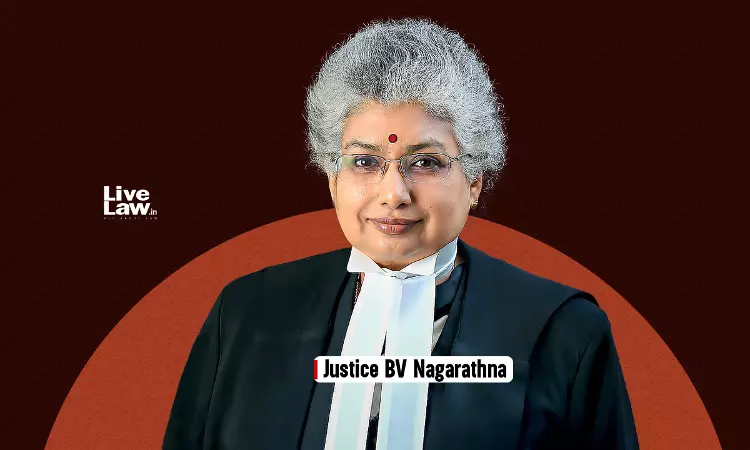
Justice BV Nagarathna yesterday observed that treating a child in conflict with the law as an adult represents one of the most delicate fault lines in the criminal justice system, as it involves balancing competing considerations such as crime and the constitutional commitment to childhood, public outrage and legislative restraints, and the impulse to punish and the philosophy of reform.
She noted that although the Juvenile Justice (Care and Protection of Children) Act, 2015, makes the nature of the alleged offence relevant in determining the statutory response, particularly in view of intense public debate over serious offences committed by adolescents, its core objectives of rehabilitation, the best interests of the child, social reintegration, and family-based care remain central to the legislative framework.
Justice Nagarathna emphasised that the Juvenile Justice Act is ultimately a law concerned with the future of the child. The intervention of the legislature and the State in a child's life, she observed, is, in a very real sense, an intervention in that child's future.
She underscored the principle that "when a child breaks the law, the law must not break the child."
Justice Nagarathna was speaking at the inaugural session of the 'National Annual Stakeholders Consultation on "Ten Years of Juvenile Justice (Care and Protection of Children) Act, 2015: Progress, Challenges and Priorities for the Next Decade".


The consultation has been convened under the aegis of the Juvenile Justice Committee of the Supreme Court in association with the United Nations Children's Fund (UNICEF).
She further pointed out an interesting fact that the legislation, amongst other things, considers institutionalisation as a measure of last resort. The judge stated that the JJ Act details two situations: 'children in conflict with law' and 'children in need of care and protection'. Based on the circumstances, the Juvenile Justice Board and the Child Welfare Committee(CWC) respond. She stated that, for instance, to cover a situation where the child has been abandoned, neglected, abused, exploited, and is without adequate parental care, the CWC becomes the institutional focal point.
"This part of the Act is important because it reveals what the statute means by care and protection. Care is not synonymous with institutionalisation. In fact, the Act expressly treats institutionalisation as a measure of last resort. The preferred objective, wherever consistent with the child's best interests, is family-based care and restoration," she said.
But otherwise, emphasis on family-based care, restoration to the family, sponsorship, adoption, etc is placed within the rehabilitation and social integration framework itself. Adoption forms part of the statute's conception of securing a child's right to family. The Act further provides the mechanism by which an orphaned or abandoned child may be declared legally free for adoption, following the prescribed inquiry.
Justice Nagarathna added that the law remains very clear on paper, but the challenges it confronts are in the implementation. She quoted the India Justice Report(2025), which found that 55% of cases remain pending before JJBs across 18 States and 2 UTs as on October 31, 2023. More than 55,000 children await the decisions, and out of 1,00,904 cases before 363 Boards during that period, only 45,097 were disposed of. Further, 111 out of 470 Boards were functioning without the full bench of a principal magistrate and two social-worker members as required by the legislation.
Pending disposal, Justice Nagarathna raised a pertinent issue as to what happens to the child after a disposed case because a disposed case is not necessarily a rehabilitated child. To answer this question, she stated that longitudinal data is important and is being received by the Supreme Court's JJ Committee.
"This is where the longitudinal data being brought to this year's consultation becomes particularly valuable. Annual submissions have been received from States by the Supreme Court Juvenile Justice Committee since 2023, together with consultations undertaken under the aegis of the High Court Juvenile Justice Committees. For the first time, this gives us an opportunity to look at movement of data over time — to identify progress, persistent bottlenecks and practices that may be capable of replication elsewhere. That is precisely the kind of evidence we need for the next decade."
Concluding, Justice Nagarathna urged that the legislation requires not just strengthening of individual institutions but also coordination amongst them. This is because the legislation doesn't merseesees a child as a file, placement or a statistic but as a person whose circumstances demand an individual response.
"No single institution can implement the JJ Act. The Board cannot do it alone. The Child Welfare Committee cannot do it alone. Nor can the judiciary, the police, the executive, legal services institutions, social workers, civil society organisations or families. The system works only when these parts work together. The next decade must therefore be about strengthening not merely individual institutions, but the connections between them."