


Corporate
Legal Representatives Can Challenge Arbitral Award Only Under S 34 Arbitration Act, Not Article 227: Supreme Court
The Supreme Court has held that the appropriate remedy for a legal representative aggrieved by an arbitral award is to file an application under Section 34 of the Arbitration and Conciliation Act, 1996, and not a petition under Article 227 of the Constitution or Section 115 of the Code of Civil Procedure."In the considered view of this Court, the appropriate relief for a legal representative...
'Very Unfortunate' : Supreme Court Flags NCLT Delay In Approving Resolution Plan, Calls For Nationwide Report
In an important development, the Supreme Court has expressed serious concern over prolonged delays in approval of resolution plans by the National Company Law Tribunal (NCLT), calling out a case where a plan has remained pending for nearly two years. A bench of Justice JB Pardiwala and Justice KV Viswanathan directed both the NCLT Principal Bench, New Delhi and the Insolvency and...
Clause Saying 'Can Be Settled By Arbitration' Does Not Create Mandate To Arbitrate : Supreme Court
The Supreme Court on Friday (April 17) held that an arbitration clause employing the word “can” does not constitute a binding arbitration agreement. A bench of Justice Sanjay Karol and Justice N. Kotiswar Singh dismissed an appeal filed against the Bombay High Court's decision, which held that Clause 25 of the Bill of Lading containing the arbitration agreement lacked the...
Death Of "Paper Shield": Re-Evaluating CA Certificates In Indian Construction Arbitration
For decades, the Indian construction arbitration landscape has been dominated by a convenient fiction: the "Certificate Culture." Claimants, faced with the daunting task of proving voluminous damages for idling, overheads, or loss of profit, have historically relied on a single sheet of paper, a Chartered Accountant (CA) certificate, as a proxy for thousands of pages of primary...
Distinction Between 'Seat' & 'Venue' Of Arbitration : Supreme Court Summarises Principles
The Supreme Court has reiterated that merely conducting arbitral proceedings at a place different from the designated seat of arbitration does not confer jurisdiction on the courts of that location. A bench of Justices PS Narasimha and Alok Aradhe set aside the Jammu & Kashmir and Ladakh High Court's decision, which had refused to entertain the Appellant's Section 34 plea for challenging...

Agricultural Land Under Valuation Rules, 2017: Who Is Qualified To Value What Law Forgot?
India holds millions of hectares of land within the corporate asset portfolios, yet the Companies (Registered Valuers and Valuation) Rules, 2017, which govern the entire framework for valuation of company assets, are silent about how the agricultural lands are to be valued, who is qualified to value them, and whether they fall within any prescribed asset class. This silence constitutes not just...
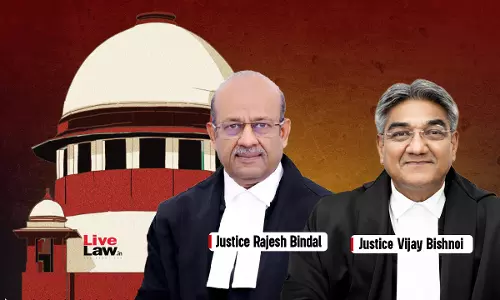
Kerala Agriculture Income Tax | Amalgamating Company's Loss Can't Be Set-Off From Income Of Amalgamated Company : Supreme Court
The Supreme Court has observed that a loss suffered by an amalgamating company cannot be set off against the income of an amalgamated company upon amalgamation unless permitted by a statute. A bench of Justice Rajesh Bindal and Justice Vijay Bishnoi dismissed a batch of appeals filed against the Kerala High Court's judgment, which declined the plea for setting off a loss of the...
Law Does Not Favour The Indolent: Supreme Court Sets Aside Arbitration Initiated After 21-Year Delay
The Supreme Court recently quashed arbitration proceedings between the State of West Bengal and a contractor, holding that the claim was ex facie time barred as the notice invoking arbitration was issued after 21 years from completion of work.“Arbitration though is an alternate dispute resolution system, which has to be encouraged, it cannot deviate from the fundamental principle that...
IBC Overrides Securities Law? NCLAT's Expanding Jurisdiction Over Frozen Demat Accounts
Can a stock exchange continue to freeze the assets of a corporate debtor even after the commencement of insolvency proceedings? More importantly, does such regulatory action survive the overarching framework of the Insolvency and Bankruptcy Code, 2016 (“IBC”), which seeks to preserve and maximize the value of the debtor's assets?These questions recently came into sharp focus before the National Company Law Appellate Tribunal (“NCLAT”) in two appeals involving BSE Limited, wherein the Tribunal...
Investments Of Multi State Co-Operative Societies Must Align With Society's Own Business As Per Bye-Laws: Supreme Court
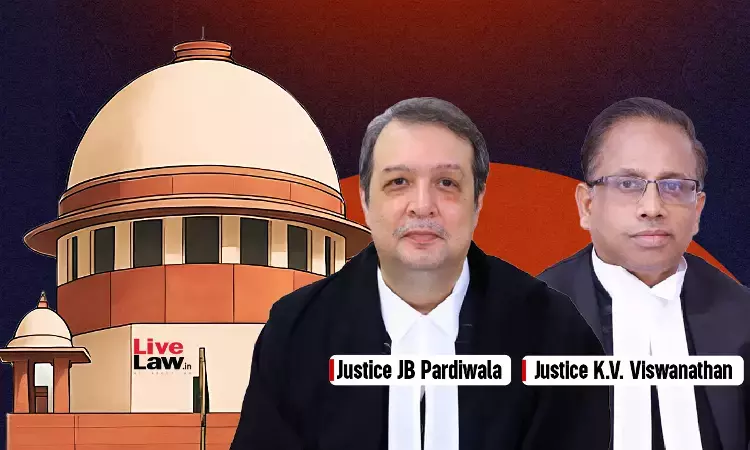
The Supreme Court has held that a multi-state co-operative society can invest in another company, including as a resolution applicant under the Insolvency and Bankruptcy Code, 2016, only if the target company is either its subsidiary or engaged in the “same line of business”.A bench of Justice JB Pardiwala and Justice KV Viswanathan clarified that Section 64 of the Multi-State...
IBC | NCLT Not To Examine If 'Pre-Existing Dispute' Will Succeed While Considering S.9 Application Of Operational Creditor : Supreme Court
The Supreme Court has reiterated that it is impermissible for the adjudicating authority under the Insolvency & Bankruptcy Code to examine the merits of the dispute while considering an application for CIRP under Section 9 by an operational creditor. It added that once the authority is satisfied that there exists a plausible pre-existing dispute, the Section 9 application would...