


Law Firm Articles
Deepfakes, Due Diligence And The Good Samaritan Paradox; How India's 2026 IT Amendment Rules Resolve Global Platform Liability Debate
The Global Problem Nobody Has SolvedThere is a question that haunts every regulator trying to govern AI-generated content. When a platform voluntarily takes down a deepfake, does that editorial judgment cost it the very intermediary immunity that allows it to function? In the US, the debate has raged under Section 230 of the Communications Decency Act, 1996 (47 U.S.C. § 230), which shields platforms from liability for user content. The catch? Courts remain split on whether active content...

Paradox Of “Self-Assessed Tax” Under Section 73 Of CGST Act, 2017: Reconciling Voluntary Compliance With Mandatory Penalty
The legislative scheme of GST acknowledges that taxpayers may occasionally commit inadvertent errors in reporting tax liabilities and therefore provides mechanisms for self-correction without immediately triggering adjudication proceedings.This philosophy finds clear expression in Section 73 of the CGST Act, 2017 which governs determination of tax not paid, short paid, or erroneously refunded in cases not involving fraud, wilful misstatement, or suppression of facts. The provision incorporates...

The HILTP Debate: Balancing Urban Evolution With Statutory Compliance
The Government of Telangana (“Government”) has introduced the Hyderabad Industrial Land Transformation Policy (“HILTP”) through G.O. Ms. No. 27 dated November 22, 2025, with the objective of addressing the rapid urbanisation that has enveloped industrial estates in Hyderabad which were established nearly five decades ago. These estates, which were originally situated on the city's periphery, now form part of the urban core, thereby creating significant socio-economic and environmental...

AI Generated Brands: The Next Wave of Trademark Litigation
Artificial intelligence has entered brand creation. Startups now generate brand names through AI tools. Marketing teams do the same. Product managers rely on AI prompts to produce hundreds of naming options within minutes.The attraction is obvious. AI promises speed and creativity. It also appears inexpensive. But a serious legal problem is emerging.AI generated brand names are entering the market without legal clearance. Trademark law was never designed for automated brand creation. Yet...
Dying With Dignity: India's Evolving End-Of-Life Jurisprudence
A Constitutional Question at the Edge of MedicineEvery generation must eventually confront a difficult question: how should the law respond when medicine can prolong life but cannot restore it?The Supreme Court's recent proceedings in Harish Rana v Union of India bring that question into sharp constitutional focus. Harish Rana suffered a catastrophic brain injury in 2013 after falling from the fourth floor of his accommodation while he was a young engineering student. The injury left him in what...
Scent Without Sense: Why India's Trademark Law Might Not Be Ready For Olfactory Marks
In a pioneering decision relating to Sumitomo Rubber Industries Ltd.'s trade mark for “FLORAL FRAGRANCE / SMELL REMINISCENT OF ROSES AS APPLIED TO TYRES,” marks the first time the Trade Marks Registry has accepted an olfactory mark as registrable under the Trade Marks Act, 1999.The Controller General of Patents, Designs, and Trademarks (CGPDT), has recently accepted a smell mark under India's trademark regime, generating significant attention and commentary. This development, hailed as a...
Personality Rights: Celebrity Rights Or Case For Identity Theft?
Personality rights in India have erupted from judicial whispers into mainstream headlines. What was once restricted to celebrities is now alarming for the masses in light of increasing proliferation of deepfakes. The intermediaries run to dodge accountability, while the ordinary person finds their face weaponised without consent. This highlights India's need to move beyond piecemeal judicial solutions and finally breakthrough with a cautiously calibrated hybrid mechanism that leverages existing...
Beyond Rights: How Indian Courts Place Welfare Of Children Above All In Custody Disputes
The question of child custody is rarely just about legal entitlement. In India, courts have consistently recognised that a child is not merely the property of parents or guardians but a human being with emotional, psychological, and social needs that demand protection. Recent judgments from the Supreme Court and High Courts underscore a progressive legal philosophy: the welfare of the child must be the paramount consideration in any custody dispute.Custody disputes often arise in emotionally...
Behind Closed Doors: Domestic Violence And The Law's Ongoing Battle In India
Domestic violence is often described as a private matter. That is exactly what makes it so dangerous. When violence happens within the home, it hides behind walls, silence, and social pressure. In India, despite strong legislation, domestic abuse continues to affect thousands of women every year across cities, villages, educated families, and economically weaker sections alike.The law is not silent on this issue. The Protection of Women from Domestic Violence Act, 2005 (PWDVA) was enacted to...
The Conundrum Of “Commercial Disputes”
A judgment by the Karnataka High Court[1] ruling that disputes arising out of or in connection with a share purchase agreement do not constitute a “commercial dispute”[2], has once again shined a spotlight on the concept of commercial disputes. In this article, we explore the judicial interpretations expounded by various courts as to what constitutes a “commercial dispute” and analyze the importance of categorizing disputes as commercial and non-commercial disputes, to help organizations...
The Digital Gavel: Navigating Adjudication Under DPDP Act, 2023
The enactment of the Digital Personal Data Protection (DPDP) Act, 2023, brings a paradigm shift in India's regulatory framework. For the first time, corporate faces a "strict-liability" mandate where data is not just a business asset, but a fiduciary relationship. Central to this new wave, is the Data Protection Board of India (DPB) which is a specialized adjudicatory body that functions as the primary enforcer of the Act.However, a critical tension has emerged: how will the DPB balance its...
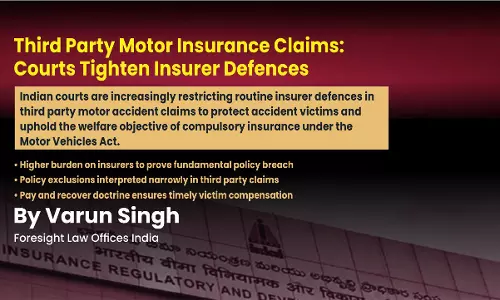
Third Party Motor Insurance Claims: Why Courts Are Tightening Insurer Defences
Motor accident compensation law in India is undergoing a quiet but decisive shift. Across Motor Accident Claims Tribunals and constitutional courts, there is a growing judicial reluctance to accept routine defences raised by insurance companies to deny or dilute compensation to accident victims. The trend reflects a broader recalibration of priorities, where social welfare objectives embedded in motor insurance law are being placed above technical objections rooted in policy fine print.Recent...