




Arbitration
Arbitration | Limitation For S. 34 Appeal Runs From Disposal Of S.33 Application Whether Allowed Or Rejected: Supreme Court
The Supreme Court on Tuesday (June 2) reiterated that the limitation period under Section 34(3) of the Act for filing an application seeking setting aside of an arbitral award would begin from the date on which a Section 33 application is disposed of. “Once proceedings under Section 33 are initiated and entertained by the Arbitral Tribunal, the award remains subject to the...

1940 Arbitration Act | Award In Arbitration Invoked During Pending Civil Suit Without Court's Leave Not Enforceable : Supreme Court
The Supreme Court has observed that during the pendency of the civil suit, an arbitral award secured by some parties under the 1940 Arbitration Act cannot be used to close the civil proceedings if the arbitration was initiated without the leave of the Court. A bench of Justice J.K. Maheshwari and Justice Atul S. Chandurkar heard the case where, during the pendency of a civil suit filed by...
Arbitration | Writ Jurisdiction Can't Be Invoked To Challenge Arbitrator's Decision Under Section 16 : Supreme Court
The Supreme Court has held that while exercising its Writ Jurisdiction, it is impermissible for the High Courts to interfere with the arbitral tribunal's order passed under Section 16 of the Arbitration & Conciliation Act, 1996. “It was not open for the learned Single Judge in exercise of writ jurisdiction to enter into the merits of the dispute while adjudicating the challenge to an...
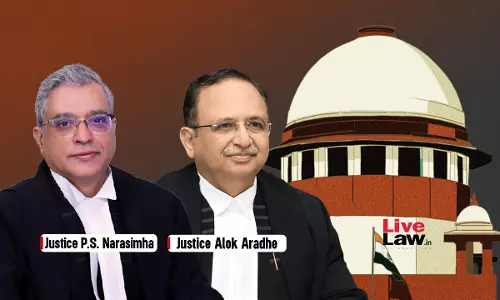
S.33(1)(a) Arbitration Act Only To Correct Clerical Errors In Award; Can't Be Invoked To Change Nature Of Interest : Supreme Court
Holding that substance of an arbitral award cannot be altered under the guise of correcting errors, the Supreme Court has ruled that changing the nature of interest awarded from simple interest to compound interest amounts to a substantive modification that falls outside the limited scope of Section 33(1)(a) of the Arbitration and Conciliation Act, 1996.A bench of Justice PS Narasimha and...
Party Estopped From Challenging Award On The Ground Of Mandate Expiry After Accepting Extension Of Arbitrator's Mandate: Supreme Court
The Supreme Court on Tuesday (May 26) has held that a party who continues to participate in arbitration proceedings without objecting to the extension of the arbitrator's mandate cannot later challenge the award on the ground that the mandate had expired. A bench of Justice Pamidighantam Sri Narasimha and Justice Alok Aradhe heard the dispute that arose out of arbitration proceedings between...

Delhi, Mumbai And GIFT City ; India's Search For A Credible Institutional Arbitration Seat?
India's oft-stated ambition is to emerge as a global arbitration hub, competing with Singapore and Hong Kong in the Asian market. To that end, India's arbitration policy has clearly shifted from ad hoc to institutional arbitration.A High-Level Committee, chaired by Justice (Retd) B.N. Srikrishna, was constituted to review the institutionalisation of arbitration in India and to make it a...
Arbitration Clause Gets Incorporated In Later Contract When Earlier Agreement Is Imported “Body and Soul” : Supreme Court
The Supreme Court observed that when a subsequent contract incorporates, in its entirety, the terms and conditions of an earlier agreement containing an arbitration clause, such incorporation is sufficient to invoke arbitration, and the later agreement need not separately express a clear intention to refer disputes to arbitration or specifically mention the arbitration clause in the...
Arbitration Act | Jurisdictional Objection Rejected By Arbitrator Cannot Be Independently Challenged Under Sections 34 Or 37: Supreme Court
The Supreme Court has held that an arbitral tribunal's decision to dismiss the plea challenging its jurisdiction cannot be challenged independently under Sections 34 or 37 of the Arbitration and Conciliation Act. The matter can be challenged only after the conclusion of the proceedings, while appealing against the award. “…there is no option for the party aggrieved by the decision of...
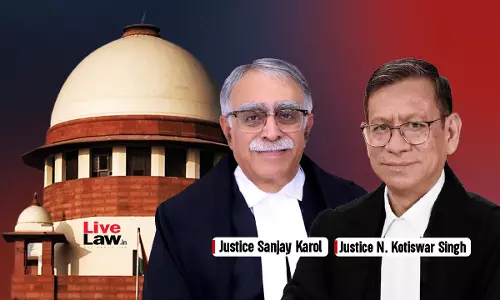
Legal Representatives Can Challenge Arbitral Award Only Under S 34 Arbitration Act, Not Article 227: Supreme Court
The Supreme Court has held that the appropriate remedy for a legal representative aggrieved by an arbitral award is to file an application under Section 34 of the Arbitration and Conciliation Act, 1996, and not a petition under Article 227 of the Constitution or Section 115 of the Code of Civil Procedure."In the considered view of this Court, the appropriate relief for a legal representative...
Clause Saying 'Can Be Settled By Arbitration' Does Not Create Mandate To Arbitrate : Supreme Court
The Supreme Court on Friday (April 17) held that an arbitration clause employing the word “can” does not constitute a binding arbitration agreement. A bench of Justice Sanjay Karol and Justice N. Kotiswar Singh dismissed an appeal filed against the Bombay High Court's decision, which held that Clause 25 of the Bill of Lading containing the arbitration agreement lacked the...