


Articles
The Soul They Could Not Amend
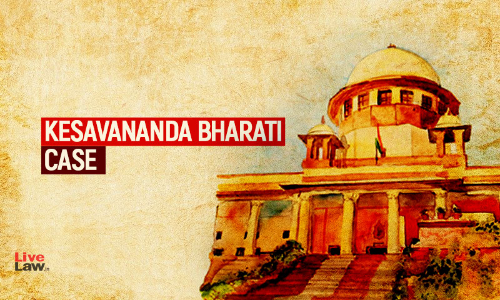
Fifty-Three Years of Kesavananda Bharati: India's Finest Constitutional HourOn the 26th of November each year, the Republic pauses to mark Constitution Day — the day in 1949 when the Constituent Assembly adopted its supreme document and gifted a continent of people their fundamental law. It is a date rightly venerated. Yet India has another date, equally consequential, equally dramatic, and almost wholly uncelebrated — the 24th of April, 1973. On that day, in a wood-panelled courtroom in New...
A Comparative Critique Of 2025 IBC Amendment
The 2025 Amendment to the Insolvency and Bankruptcy Code introduces structural shifts that mirror international best practices. Whether India's ecosystem is ready to absorb them is the more urgent, and far less comfortable, question.Nine Years On, A New WagerThe Insolvency and Bankruptcy Code (“the Code”) 2016 is often hailed as the most significant economic reform since the 1991 liberalisation. The pre-existing insolvency landscape was a creditor-hostile regime, scattered with numerous...
Doctrine Of Merger Vis-à- Vis Order 9 Rule 13 Explanation
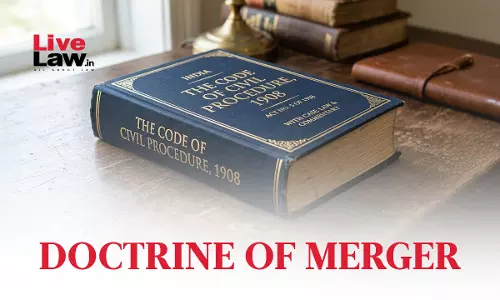
Code of civil procedure, 1908 (CPC) does not provide for the definition of ex- parte decree or ex-parte judgment. The term ex parte is a Latin term which means “from one side” or “or for one party only”. In other words, in an ex parte proceeding the case of the plaintiff proceeds in the absence of the defendant.HISTORY OF THE PROVISIONProcedures analogous to ex parte proceedings can be found as far back as Roman law. The provision regarding setting aside of an ex parte decree first found it...

Denied Entry At NLUs? Reservation Policy In Shadow Of Economic Barriers
“Opportunity to acquire education cannot be confined to the richer section of the society.” - Mohini Jain v. State of Karnataka (1992).As admissions to undergraduate and postgraduate programmes at National Law Universities (NLUs) proceed this season, a structural problem that has persisted for years demands renewed attention. NLUs occupy a pre-eminent position in India's legal education landscape, often ranked alongside the IITs, IIMs, and AIIMS. Yet for students from Scheduled Caste (SC) and...
Quiet Interrogations: Custody In Issue, Parenting In Fragments
Quiet Interrogations is a reflective series that examines the subtler tensions within the law—where formal doctrine may appear settled, yet lived reality continues to raise difficult questions. In this essay, it turns to custody litigation to explore how disputes over a child often expand into the fragmented judicial management of parenting itself, and why family process must move from serial applications toward a more thoughtful structural design. ……………………………….. A guardianship...
Conversion As Cure? A Re-look At The Loss Of Scheduled Caste Status
The Supreme Court (the SC) in Chinthada Anand v. State of Andhra Pradesh reiterated the legal position that conversion to religions other than Hinduism, Jainism, or Sikhism results in the loss of Scheduled Caste status.[1] The petitioner had challenged an order of the Andhra Pradesh High Court quashing the FIR against the respondents. The respondents had allegedly beaten and hurled casteist slurs against the petitioner, a member of the Hindu-Madiga community (categorised as Scheduled Caste). The...
Finding The Next Date
Waiting for the next date can be anxiety-inducing. I don't mean that romantically. I'm referring to what most litigants face as their cases wind through the Indian justice system. Two questions that counsel routinely receive from clients are 'what happened in my case' and 'when is the next court hearing date'. The answer to the second question – the hearing date – is more complex than meets the eye.The Supreme Court of India, after a preliminary hearing, sets subsequent hearing dates in a few...
![US Supreme Courts Tariff Decision: A Moment Of Constitutional Reassertion [Part II]](https://www.livelaw.in/h-upload/2022/02/18/500x300_410057-new-york-supreme-court-donald-trump.jpg "US Supreme Courts Tariff Decision: A Moment Of Constitutional Reassertion [Part II]")
US Supreme Court's Tariff Decision: A Moment Of Constitutional Reassertion [Part II]
In a landmark decision that will be remembered as a moment of constitutional reassertion, the Supreme Court of the United States (SCOTUS/the Court) has declined to read the words 'regulate importation' under Section 1702(a)(1)(B) of the International Emergency Economic Powers Act (IEEPA) as a charter for unbridled presidential authority to impose tariffs. In doing so, the Court set aside one of the most consequential assertions of unbounded executive authority by US President Donald Trump. As...
Critical Minerals And India-NSW Corridor: A Legal Roadmap
An analysis of the statutory, investment and arbitration frameworks governing the bilateral opportunity in the Indo-NSW CorridorThe global energy transition has produced a new class of strategic asset. Lithium, cobalt, rare earth elements and a handful of other minerals are now as consequential to national industrial policy as oil was to an earlier generation. Electric vehicles, renewable energy infrastructure and advanced defence technologies are all critically dependent on secure and reliable...

Section 23(4) Of Arbitration Act; An Arbitrator's Quagmire
Section 23(4) of the Arbitration and Conciliation Act, 1996 (“Arbitration Act”) is a peculiar sub-section. It was inserted like a Lego block within Section 23 of the Arbitration Act in 2019. The marginal note of Section 23 reads, “Statements of claim and defence”. The marginal note employs the plural noun “Statements” unlike sub-section 4 which uses the singular noun “The statement”. Section 23(4) states that “the statement” (singular) of claim “and” defence “shall be completed within a period...
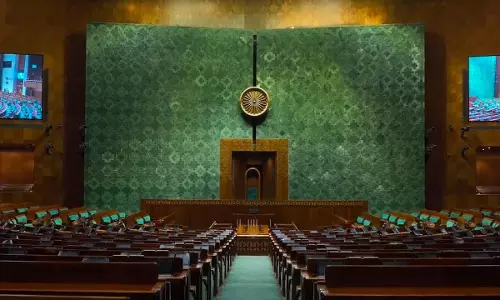
Recasting Representation Or Undermining Federalism? A Critical Look At Constitution (131st Amendment) Bill, 2026
India stands at a constitutional crossroads with the introduction of the Constitution (131st Amendment) Bill, 2026, a proposal that seeks not merely to expand the Lok Sabha to 850 seats but to recalibrate the very grammar of political representation in India. While the stated objective is to align representation more closely with demographic realities, the amendment raises a foundational question - can numerical equality alone define democratic legitimacy in a Constitution that is equally...