


Thiruparankundram Hill | Supreme Court Stays Madras HC Judgment, Allows Karthigai Lamp Lighting At Deepathoon On Nov 24 As One-Time Measure
Gursimran Kaur Bakshi
20 Nov 2026 1:49 PM IST
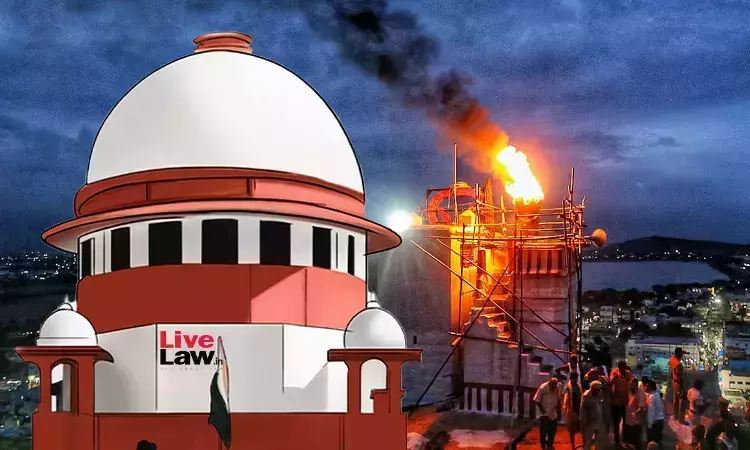
The Supreme Court on Friday(November 20) stayed the Madras High Court judgment permitting the lighting of the ceremonial Karthigai Deepam lamp at the Deepathoon (stone pillar) near a Dargah atop Thiruparankundram hill in Madurai.
However, as a one-time measure, the Court permitted the lighting of the lamp at the Deepathoon on November 24, the Karthigai Deepam day this year. The Court clarified that this arrangement should not be construed as a final endorsement of the claimed custom of lighting the lamp at the disputed location.
The permission granted by the Court cannot be relied on by any party as evidence of any established custom, the Court clarified. The present arrangement cannot be an independent basis for claiming similar performances in subsequent years.
"The present arrangement does not proceed on any finding that the stone pillar is or has historically been a place of customary religious observance, nor does it determine whether the lighting of the lamp at the said location constitutes an essential religious practice or whether any individual, institution or denomination possess any enforceable right in that regard," the Court observed.


A bench comprising Justice Aravind Kumar and Justice Vipul M Pancholi directed that only authorised representatives of the Devasthanam (temple administration) and government officials would be permitted to access the location for the ritual. The general public would not be allowed to go to the Deepathoon. No procession, public congregation, slogan-raising or demonstration shall be allowed during the ceremony.
The Court also directed the authorities to ensure adequate security arrangements and permitted the deployment of the Central Industrial Security Force (CISF), if necessary.
Supreme Court's findings
Pronouncing the order, the bench observed that various important questions were arising out of the present case, including the ambit of religious rights under Articles 25 and 26. The Court said that it was not going into these questions at the present juncture and that they will be considered at the appropriate stage.
The Court further noted that the fact that two judicial forums, the single bench and the division bench, have allowed the performance of the ceremony at the disputed location was a significant consideration for interim relief. At the same time, the Court said that its observations should not be construed as an approval of the High Court's reasoning.
The Court said what weighed with it at the present stage was the "peculiar nature of the occasion" and the "proximity of the festival". "The opportunity to perform the festival on the said date (November 24), if denied, cannot be restored by a subsequent adjudication. Equally, we are conscious of the fact that the performance of the ceremony, once performed, cannot be undone," the Court said, stating that the interim arrangement must be narrowly confined.
The Court therefore said that a limited one-time arrangement, with stringent safeguards, will balance the interests.
The Court therefore directed that the findings recorded in paragraphs 1 to 140 of the High Court Division Bench's judgment dated 06.01.2026, in so far as the challenge in the present proceedings, will remain stayed until further orders.
However, the Court felt it appropriate to permit the lighting of the ceremonial lamp on November 24 at the stone pillar identified as the Deepathoon through a restricted team organised by the Devasthanam. The Madurai District Collector shall settle the composition and the number of the team in consultation with the Temple Executive Officer, Archaeological Survey of India and the Madurai Commissioner of Police. The District Collector shall act as the nodal officer.
The District administration shall settle the time and the route considering the relevant factors, and the team shall immediately leave the place after the ceremony. No erection of any structure, structural alterations, excavation or permanent construction shall be permitted.
The enjoyment of the Dharga and the mosque shall not be interfered with.
Arguments so far
Senior Advocate Jaideep Gupta(State of Tamil Nadu), Senior Advocate Gopal Sankaranarayanan(Tamil Nadu District Collector), Senior Advocate Shekhar Naphade( HR&CE Commissioner), and TN Additional Advocate General Prashanto Chandra Sen made their arguments, urging a stay of the High Court's judgment.
To summarise their arguments, the counsels have categorically stated that there is no custom of lighting the lamp at the Deepathoon. They have reiterated that, as per the Agamas, the lamp is traditionally lit at the place near Uchi Pillaiyar temple.
Senior Advocate Huzefa Ahmadi for the Sikandar Badhusah Dharga and Senior Advocate Amit Tiwari(Hazarath Sulthan Sikkandar Badhusha Avuliya Dargah) made arguments, contending that they are the most affected in this case.
Ahmadi contended that the single judge made a site visit without notice to the Dharga. He submitted that if a new custom is sought to be established, it must be through a suit and not a writ proceeding.
Tiwari stated that the 1923 decree makes it clear that the Dargah has the whole ownership of the entire hillock. He contended the observation of the single judge that the Dargah is only entitled to the Nellithophe area, flight steps cut out of the rock towards the mosque and the actual site where the mosque stands, were wrong.
Arguments were also made by Senior Advocate Narender Hooda on behalf of a priest who supports the State's position. He told the Court that the hill is very secular because it has Jain caves, Kashiviswanathan temple, dargah etc and attempts previously made to light the lamp there have been negated. He also pointed out that in a 2024, when the Dharga wanted to hold animal sacrifice within their own premises, the permission was refused. The High Court held that if a new custom had to be established, it has to be done through a custom. However, when it came to the claim of custom regarding Deepathoon, it has been allowed in a writ petition, he contended.
Arguments on behalf of the writ petitioners seeking lamp lighting at the Deepathoon.
Senior Advocate Guru Krishnakumar (for the lead petitioner) showed photographs to the Court, which are annexed with the Madras High Court order by the division bench. He stated that the photos clearly show that there are two peaks and the Deepathoon is not on the same peak as the dargah.
He also termed the arguments made in regard to the ownership of the entire hillock as "red herring". He stated that the findings are limited to the peak where the mosque and the dargah stand and not the Deepathoon, which is on the adjacent hills. He stated that attempts to include the flagstaff in the area owned by the Dargah were "spurned" by the Courts.
Background
It may be recalled that the status quo was granted by the Supreme Court after a series of orders where passed by the Madras High Court for lighting the lamp at Deepathoon. A single judge in December last year, allowed lighting of the lamp at that stop, which was upheld by the division bench of the High Court in January.
The High Court's order was passed in writ petitions filed by individuals who sought the right to light a lamp at the 'Deepa Thoon' (stone lamp pillar) atop the Thirupparankundram hills.
The spot is located about 50 meters away from a Dargah on the hill. The State HR&CE Department, which manages the Lord Subramaniya temple at the bottom of the hill, opposed the plea, contending that there was no custom of lighting the lamp at the Deepa Thoon, as it was customarily lit at another spot.
Justice GR Swaminathan of the High Court allowed the writ petition, observing that the rights of the Dargah were not affected by the act, and stopping the lamp-lighting would violate the rights of the devotees.
The refusal of the State administration to allow the lamp-lighting led to contempt proceedings, where Justice Swaminathan passed orders to execute the act with the protection of CISF forces. The division bench upheld the orders passed by Justice Swaminathan in contempt proceedings. Challenging the dismissal of the contempt proceedings, the State had filed an SLP in December last year, but the same never got listed in the Supreme Court.
In January, a division bench upheld the original orders passed by Justice Swaminathan in the writ petitions, holding that the lighting of the lamp will not cause any law and order problem. The division bench held that the temple management has the duty to protect the traditions. The division bench also rejected the argument of the State that the 'deepa thoon' was a survey stone erected by the British rulers.