


Delhi Union Of Journalists Moves Supreme Court Alleging Police Violence During Delhi Protests, Seeks Protection For Independent Reporters
Gursimran Kaur Bakshi
14 Oct 2026 2:48 PM IST
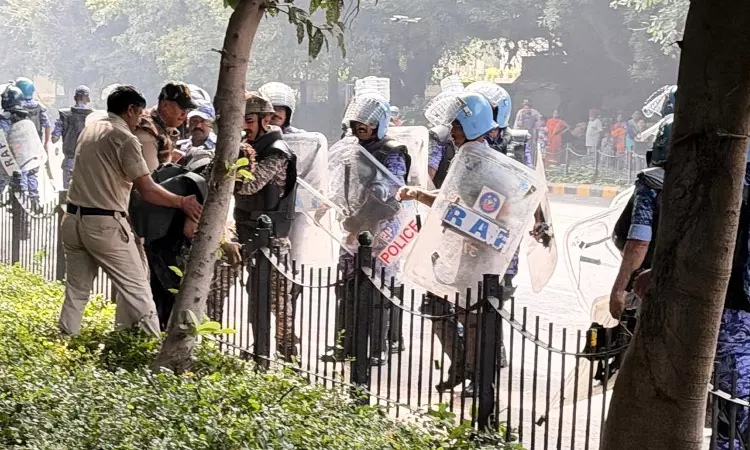
The Delhi Union of Journalists (DUJ) has filed a writ petition before the Supreme Court over the alleged detention, assault, and obstruction of journalists covering protests in Delhi on 10 and 11 October 2026.
It has submitted that reporters were forcibly removed from reporting sites, prevented from recording events, and subjected to physical force. It also refers to allegations concerning the taking of phones, cameras and microphones, and complaints by women journalists about intrusive searches and physical misconduct.
Among the accounts relied upon is the signed statement of senior journalist Paranjoy Guha Thakurta, who states that he was detained on 10 October despite showing his Press Information Bureau (PIB) accreditation card, without being supplied grounds or detention papers. The petition also cites a Committee to Protect Journalists report recording at least 35 journalist detentions in Delhi during the two days.


DUJ submits that interference with lawful reporting affects both the rights of journalists and the public's ability to receive information. The petition raises these issues under Articles 14, 19, 21 and 22 of the Constitution.
"The right under Article 19(1)(a) belongs to Indian citizens. It does not depend upon employment with a news organisation or satisfaction of a statutory definition governing employment benefits. A journalist who leaves an organisation and continues reporting independently, or a citizen who communicates news through a digital platform, retains constitutional protection. Reporting remains subject to lawful and proportionate restrictions," it has stated.
A central issue raised in the petition is the alleged use of the Delhi Police advisory dated 5 October 2026 to prevent reporting by persons without government accreditation or an employer-issued press card. DUJ contends that accreditation facilitates access to designated official sources and cannot be treated as a general licence to report events in public places.
The petition argues that the constitutional protection of lawful reporting extends to independent journalists, freelancers and citizens communicating news through YouTube and other digital platforms. Employment with a recognised news organisation or possession of a PIB or DIP card cannot, by itself, determine who may gather and communicate news.
The petition further refers to the Supreme Court's order dated October 11 directing that journalists and other professionals should not be hindered in performing their professional duties. It also records the NHRC's notice concerning the reported sexual harassment of three women journalists during an earlier protest on 3 October.
Prayers
The Petitioner accordingly seeks protection of lawful reporting irrespective of accreditation; an independent and time-bound inquiry; immediate preservation of relevant evidence; return of equipment unlawfully retained, and appropriate action and compensation where violations are established. It also seeks practical safeguards for reporters covering public events, including women reporters.
DUJ has approached the Court in its representative capacity for its members and other affected journalists, including independent reporters and freelancers. The petition has been filed through Shashank Singh, Advocate-on-Record, Supreme Court of India.