



- Home
- /
- Top Stories
- /
- Don't Completely Stop Trains/Metro...
Don't Completely Stop Trains/Metro In Delhi To Handle October 10 Protests : Supreme Court To Centre
Debby Jain
9 Oct 2026 3:37 PM IST
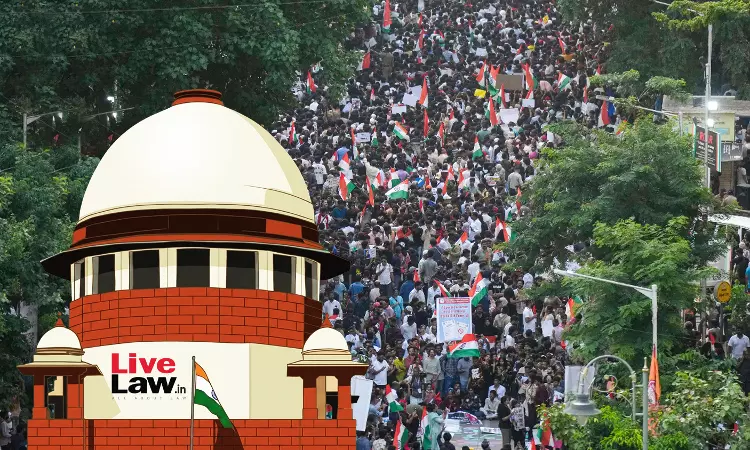
The Court asked the Centre to allow the services in a regulated manner so that the general public is not put to inconvenience.
The Supreme Court on Friday directed the Centre not to completely stop train services to Delhi and close the Delhi Metro stations ahead of the October 10 protests announced by the CJP and opposition parties in the national capital against the Chief Election Commissioner.The Court asked the Centre to allow these services in a regulated manner, keeping in mind the principles of proportionality,...
This is a premium content
Available exclusively to
Our subscribers
Subscribe Premium 
INR 1099+GST
Your support helps us to bring you more content at
an affordable subscription scheme !!!
All payment options available
The Supreme Court on Friday directed the Centre not to completely stop train services to Delhi and close the Delhi Metro stations ahead of the October 10 protests announced by the CJP and opposition parties in the national capital against the Chief Election Commissioner.
The Court asked the Centre to allow these services in a regulated manner, keeping in mind the principles of proportionality, so that the public is not inconvenienced.
The Court noted that Mail/Express trains arriving in New Delhi and Nizamuddin Railway Stations tomorrow have been instructed to be cancelled, and 57 Delhi Metro stations are to be closed from 9 PM today. The Court observed that the "notifications are overreaching, as they impose a complete ban upon essential public transportation".
Responding to the Court's observation that regulation cannot amount to complete prohibition, the Solicitor General of India assured that he will impress upon the authorities to allow the services in a regulated manner.
The Court also directed the Centre to give due publicity to the advisory so that no hardship is caused to the public.
A bench comprising Chief Justice of India Surya Kant, Justice Joymalya Bagchi and Justice V Mohana was hearing the petitions filed by CPI(M) General Secretary MA Baby and other petitioners challenging the curbs imposed by the authorities ahead of the protests.
After the matter was heard following an urgent mention made by Senior Advocates Kapil Sibal, Gopal Sankaranarayanan, Dr AM Singhvi, N Hariharan, Vrinda Grover etc, the Court passed the following order :
"It appears that the notifications are overreaching, as they impose a complete ban upon essential public transportation. Upon our indication that a distinction exists between total 'prohibition' and the 'regulation' of Metro and other train movements, learned Solicitor General of India has fairly agreed to impress upon the authorities to reassess such prohibitions. Consequently, they will permit the operation of Metro trains and other rail services in such a regulated manner, that no inconvenience is caused to the residents and general public of Delhi, while adhering to the principles of proportionality.
Regarding that assurance, we clarify that although there shall be no outright prohibition on the movement of Metro trains, a prudent decision may be made to permit the operation of Metro trains and other rail services in a suitable and regulated manner. Such a decision should be widely publicised to prevent further inconvenience."
Court expresses concerns over public hardship
During the hearing, the Court shared its concerns over the impact of the curbs on the general public.
Addressing Solicitor General of India Tushar Mehta, CJI Surya Kant said :
"Solicitor...we are mainly concerned about the complete closure of these metro station entries. We have serious concerns about this. Our concern is not with respect to any protesters or any individual. Our concern is about the hundreds and thousands of commuters who come from Gurugram, Greater Noida, East Delhi and South Delhi to Delhi for their livelihood. They are students, employees and senior citizens who travel by public transport. We are speaking on behalf of the common citizens of this city. The law enforcement authorities are certainly entitled to take regulatory measures. There is no doubt about that. If you want to restrict unruly movement, you can do so. But that does not mean you can bring everything to a halt and leave people without any transport facility. Everybody does not have a car. Everybody does not have access to private transport. People depend on public transport."
SG Tushar Mehta agreed to discuss the matter with the authorities.
Senior Advocate Kapil Sibal said that the trains which are scheduled to reach New Delhi and Nizamuddin railway stations between 4 AM to 2 PM on October 10 have been suspended. "It means a Kerala train can't come here if it's reaching Delhi," Sibal said.
CJI Surya Kant told the Solicitor that the principle of proportionality has to be followed while
"One celebrated principle is of proportionality. Do only to the extent...that principle need to be kept in mind. Maybe that out of abundant precaution, you have done it, you do that. Law and order is your responsibility. It's not state property only. There are daughters, senior citizens...they travel, they also need to be protected. No difficulty in measures, but make sure that everything is not halted," CJI said.
Justice Bagchi said that as per the notice, several metro stations will be closed from 9 PM today until further orders. While reduction of frequency can be a regulation, complete closure of services would be an extreme step, the judge suggested.
"Regulate movements of trains, but don't stop it altogether," Justice Bagchi said. SG said that depending on the circumstances, complete stoppage might be a proportionate measure.
Senior Advocate Chander Uday Singh said that there cannot be any anticipatory shut down of services.
The Solicitor said that the impression given by the petitioners that the entire city has been shut down is far from the truth, and claimed that the authorities have only taken proportionate measures in view of the violence which followed the July 20 Parliament march attempt by CJP protesters.
The SG added that the internet shutdown is only effective in certain sensitive pockets, and that too will be reviewed based on the security inputs.
SG added that many lady police officers were harassed and molested by the protesters earlier this week, and urged the bench to see the videos.
The bench stated that it is confining the consideration only to the issue of transport services. When Vrinda Grover raised the issue of police visiting mosques and advising people not to join the protests, the Court said that it was not going into those issues since none of the organisers of the protest are before the Court.
Case : MA Baby v. Union of India and others | WP(c) 63560/2026
#JantarMantarProtest: #SupremeCourt to hear today a batch of petitions filed in connection with the student protests that took place in July over NEET exam paper leak and other irregularities One of these petitions was mentioned recently before the CJI bench seeking directions to the #DelhiPolice for allowing peaceful protest in Delhi amidst concerns regarding #CECGyaneshKumar's actions and Election Commission's SIR of electoral rolls Bench: CJI Surya Kant, Justice Joymalya Bagchi and Justice V Mohana. @Cockroachisback @CJP_for_India @neha_aisa #DelhiProtest
— Live Law (@LiveLawIndia) October 9, 2026
Debby Jain
Debby Jain is a Correspondent with LiveLaw, covering the Supreme Court of India

