



Not My Domain? Chief Justice, Street And Supreme Court's Selective Reach
Shashank Shekhar & Wasiullah
4 Nov 2026 3:00 PM IST
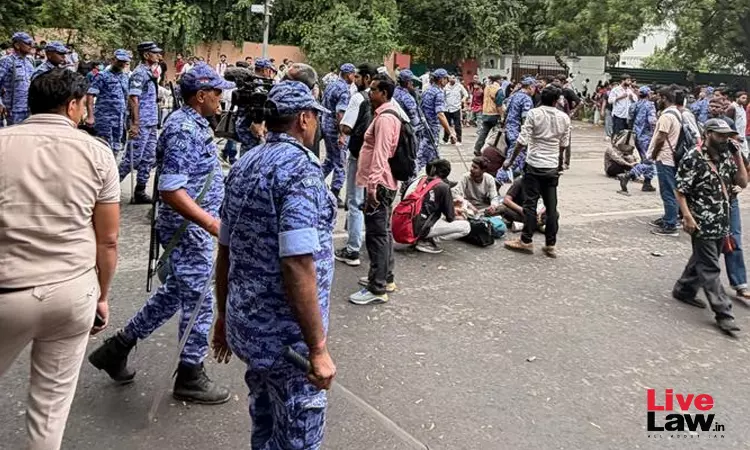
On 12 October 2026, asked about protests demanding the resignation of Chief Election Commissioner Gyanesh Kumar, Chief Justice of India Surya Kant told reporters: “This is a law-and-order issue. It is not my domain.” Policing belongs to the executive, but whether policing respects Articles 19 and 21 belongs to the Court, and treating the two as one abandons the second. The Chief Justice's own docket from that week shows the confusion at work.
Three days earlier, the Chief Justice's own bench had already entered the domain he later disclaimed. On 9 October, a bench of the Chief Justice and Justices Joymalya Bagchi and V. Mohana told the Centre not to halt trains and Metro services into Delhi completely, and recorded that “it's high time that some suitable place where all basic amenities can be provided for peaceful and lawful protestors needs to be identified and designated.” A court that regulates the Metro and records a plan to relocate protest is governing public order; it simply chose to govern the logistics rather than the legality. The legality was the question that mattered, because the state's response was already escalating.


What the Court left unexamined was the coercive core of that response. Prohibitory orders under Section 163 of the Bharatiya Nagarik Suraksha Sanhita (BNSS) were in force, protesters were detained at Jantar Mantar, and on 12 October the Delhi Police de-notified Jantar Mantar as a protest site, moving dissent to Ramlila Ground, Burari and East Delhi. Prohibitory orders, detentions and the removal of a protest site are exactly the measures the Constitution asks courts to test for proportionality. The Court's own precedents say so in terms.
No “law and order” exception to Article 32
The Supreme Court has repeatedly held that public-order measures against protest are open to judicial review. In In Re: Ramlila Maidan Incident (2012), reviewing the midnight police action against Baba Ramdev's supporters, it held:
“Citizens have a fundamental right to assembly and peaceful protest which cannot be taken away by an arbitrary executive or legislative action.”
The phrase “arbitrary executive action” places police conduct squarely before the Court, not outside it. Six years later, the Court applied that principle to the very site now de-notified.
In Mazdoor Kisan Shakti Sangathan v. Union of India (2018), the Court held that even genuine hardship to residents could not justify a blanket ban on protest at Jantar Mantar:
“Though this analysis of the NGT is without blemish, we, however, feel that the solution was not to ban the demonstrations altogether. Instead, the NGT would have directed the authorities to adopt such measures … so that there is a balancing of the rights of both the sections of the society.”
The Court did not leave that balance to the police; it struck the balance itself. Two years later, Anuradha Bhasin turned that balance into a test for every prohibitory order.
Anuradha Bhasin v. Union of India (2020) supplies the standard every Section 163 order in Delhi must meet:
“The power under Section 144, Cr.P.C cannot be used to suppress legitimate expression of opinion or grievance or exercise of any democratic rights.”
The bench of Justices N.V. Ramana, R. Subhash Reddy and B.R. Gavai added that repeated orders are an abuse of power and that such orders must be published so they can be challenged. Section 163 of the BNSS reproduces Section 144, so Bhasin applies directly, and only a court can say whether Delhi's orders pass it. Whether the Court asks that question has depended less on doctrine than on who presides.
Two decades of Court's record on protest
The Court's record on protest and public order splits into two lines, and the line taken has tracked the Chief Justice rather than the law.
Year | CJI | Episode | Court's posture | What changed on the ground |
|---|---|---|---|---|
2026 | Surya Kant | Regulated Metro shutdown; recorded relocation suggestion; | Jantar Mantar de-notified; Section 163 orders unexamined | |
2024 | Sanjiv Khanna (Gavai, Viswanathan JJ.) | Pan-India guidelines; contempt for breach | Mandatory notice and videography; enforcement uneven | |
2023 | D.Y. Chandrachud | "Complete breakdown" of machinery; DGP summoned | Court-appointed oversight of probes, though three months later | |
2021 | N.V. Ramana | Suo motu; questioned non-arrest of minister's son | Accused was arrested next day; bail was cancelled | |
2021 | S.A. Bobde | "We are not the first authority" | Left wholly to Delhi Police | |
2020 | S.A. Bobde | Dissent only in "designated places" | Template for later relocation of protest | |
2020 | S.A. Bobde | "We cannot give preventive reliefs" | High Court told to hear sooner; | |
2019 | S.A. Bobde | "Let the rioting stop"; sent to High Courts | No Supreme Court-monitored inquiry | |
2018 | Dipak Misra | Preventive, remedial, punitive directions | No central anti-lynching law; compliance chased for years | |
2018 | Dipak Misra | Blanket ban set aside | Protest site restored, until October 2026 | |
2012 | S.H. Kapadia | Police action held excessive | Right to protest affirmed; compensation docked for "contributory negligence" | |
2006 | Y.K. Sabharwal | Seven binding directions | No State fully compliant 15 years later |
When the Court engaged, the state changed course within days; when it stood aside, the authority under challenge judged its own case. One judge's record shows both lines at once.
Chief Justice Surya Kant has sat on both sides of this ledger. He was on Chief Justice Bobde's bench that pleaded helplessness during the Delhi riots, and on Chief Justice Ramana's bench that forced an arrest in Lakhimpur Kheri. He therefore knows from experience which orders protects rights.
The deferential line
The deferential line began by making relief conditional on the victims' calm. On 16 December 2019, after police entered the Jamia Millia Islamia campus, Chief Justice S.A. Bobde refused to hear the students until “the rioting” stopped, and the next day sent them to the High Courts. The complaint was police excess, yet the Court asked the complainants to behave before it would listen. Three months later, it extended that reasoning to a riot in progress.
During the Delhi riots, the Court disclaimed the power to prevent harm altogether. On 2 March 2020, as victims sought FIRs against politicians for hate speech, the bench said: “We cannot stop things from happening. We cannot give preventive reliefs.” Preventive relief is the ordinary business of writ jurisdiction, from habeas corpus to injunctions, so the claim misdescribed the Court's own powers. A year later, the Court used the words “law and order” to stand aside again.
In the farmers' tractor-rally case, at least, the Court's restraint was even-handed. In January 2021 it told the Attorney General “We are not the first authority” and refused the Centre its injunction against the protest. Neutral restraint of this kind leaves protest rights intact, and it may be what the Chief Justice meant last week. The danger comes when restraint hardens into doctrine that favours restriction, as it did in Shaheen Bagh.
Amit Sahni v. Commissioner of Police (2020) turned deference into doctrine by confining dissent to “designated places”:
“…public ways and public spaces cannot be occupied in such a manner and that too indefinitely. Democracy and dissent go hand in hand, but then the demonstrations expressing dissent have to be in designated places alone.”
The judgment never said who designates a place or what makes it adequate. October 2026 has answered both questions, and the answers should trouble the Court.
The designation has now been used to move protest away from power, with the Supreme Court's recorded approval. Delhi Police de-notified Jantar Mantar three days after the Court recorded the Solicitor General's statement that a new site would be considered, although MKSS had warned that Ramlila Maidan “has its own limitations” for this purpose. A designated-places doctrine protects dissent only if a court polices the designation. The other line of cases shows what such policing looks like.
The interventionist line
Tehseen S. Poonawalla v. Union of India (2018) named law and order as a constitutional duty the Court would enforce. Chief Justice Dipak Misra's bench held:
“The horrendous acts of mobocracy cannot be permitted to inundate the law of the land. Earnest action and concrete steps have to be taken to protect the citizens from the recurrent pattern of violence which cannot be allowed to become 'the new normal'.”
The Court told the States that preventing vigilantism was their obligation and its concern, and issued preventive, remedial and punitive directions. Its weakness was follow-through: the case went unheard for long stretches. Lakhimpur Kheri shows what follow-through achieves.
Sustained attention in Lakhimpur Kheri produced an arrest within a day. On 8 October 2021, Chief Justice Ramana's bench, with Justices Surya Kant and Hima Kohli, asked Uttar Pradesh what message it was sending by serving a notice on a murder accused; Ashish Mishra was arrested the next day, and in April 2022 the same bench cancelled his bail. The state moved because the Court kept the case and kept asking. Manipur shows the same effect even when the Court arrives late.
Even a late intervention in Manipur changed how the state investigated. The Court had declined urgent listing of a challenge to the internet shutdown in July 2023, but on 1 August Chief Justice Chandrachud's bench asked whether there was “a complete breakdown of law and order and constitutional machinery” and summoned the Director General of Police in person. Within a week, a court-appointed panel was overseeing the probes.
The demolitions case went further, binding officials before they act.The bulldozer judgment proves that the Court can give preventive relief. In November 2024, Justices B.R. Gavai and K.V. Viswanathan held:
“If the executive acts as a judge and inflicts penalty of demolition on the citizen on the ground that he is an accused, it violates the principle of separation of powers.”
The Court then required 15 days' notice, videography and personal liability of officials, enforceable through contempt: exactly the preventive relief the 2020 bench said courts cannot give. Whether such rules hold, however, depends on what the Court does after judgment.
Judgments without follow-up
Principles announced and then abandoned barely change state behaviour. Anuradha Bhasin required internet shutdowns to be published, temporary and proportionate, yet Access Now's count shows India averaged about 94 shutdowns a year in the six years after the judgment, slightly more than the 88.5 a year before it.

Chart 1. Data: Access Now / #KeepItOn annual reports, 2016–2025.
The judgment was right, but it left review to an executive committee and the Court never audited compliance. Police reform shows the same pattern over twenty years.
Twenty years after Prakash Singh, no State fully complies with the Court's police-reform directions. CHRI's assessments of the 2006 directions, which aimed to insulate the police from political control, found this across the board:

Chart 2 Data: CHRI compliance assessments, 2020–21.
Former Law Commission chair Justice A.P. Shah has pointed out that the Court did not pursue contempt against defaulting States. The result is a police force still answerable to the political executive, deciding which protests against that executive may proceed. That is why the Chief Justice's words matter beyond one exchange with the press.
“Not my domain” is wrong as a statement of jurisdiction. Ramlila, MKSS and Bhasin hold that public order belongs to the executive but the limits on it belong to the Court. When the Court engaged, the state changed; when it stood aside, the challenged authority judged its own case. An arrest followed in a day, a police chief appeared in a week, and bulldozers acquired a notice period. Each result came from a Chief Justices who treated the street as the Court's concern.
The Chief Justice needed only one sentence: Section 163 orders are reviewable, and this Court will review them. Until it says so, it's open doors face an empty street.
Authors Shashank Shekhar & Wasiullah are Assistant Professors of Law at Lloyd Law College, Greater Noida. Views are personal.