



- Home
- /
- High Courts
- /
- Allahabad High Court
- /
- Codeine Cough Syrup Within...
Codeine Cough Syrup Within Permitted Quantity Attracts NDPS Act If Stocked Or Sold For Intoxication: Allahabad High Court
Upasna Agrawal
7 Sept 2026 9:33 AM IST
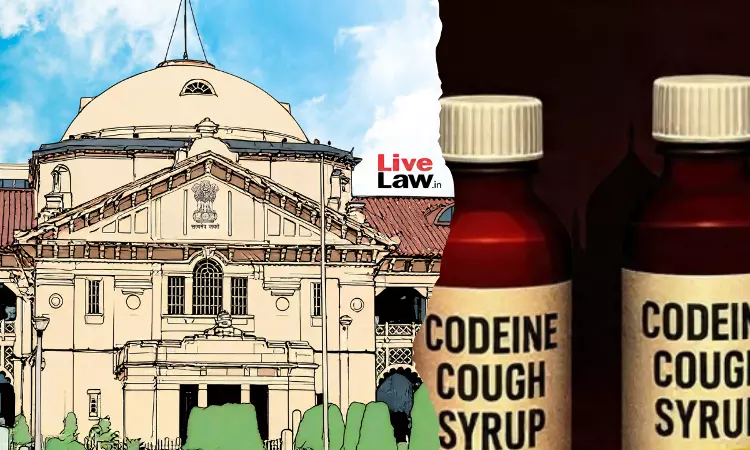
The Allahabad High Court has held that codeine-based cough syrup carrying codeine within the permitted limit is not a narcotic drug so long as it is sold or transported for medicinal use, but that the moment it is stocked, sold or transported to be used as an intoxicant, the exemption is lost and it becomes a codeine preparation attracting the Narcotic Drugs and Psychotropic Substances...
This is a premium content
Available exclusively to
Our subscribers
Subscribe Premium 
INR 1099+GST
Your support helps us to bring you more content at
an affordable subscription scheme !!!
All payment options available
The Allahabad High Court has held that codeine-based cough syrup carrying codeine within the permitted limit is not a narcotic drug so long as it is sold or transported for medicinal use, but that the moment it is stocked, sold or transported to be used as an intoxicant, the exemption is lost and it becomes a codeine preparation attracting the Narcotic Drugs and Psychotropic Substances Act, 1985.
Entry 35 of the Central Government notification dated 14.11.1985, issued under Section 2(xi)(b) of the NDPS Act, declares codeine and its salts, dilutions and preparations to be manufactured drugs, excepting preparations compounded with one or more other ingredients which contain not more than 100 milligrams of the drug per dosage unit, have a concentration of not more than 2.5% in undivided preparations, and have been established in therapeutic practice.
Section 8(c) of the NDPS Act bars dealing in any narcotic drug or psychotropic substance except for medical or scientific purposes, and except in the manner allowed by the Act, the rules and orders made under it and the terms of any licence, permit or authorisation.
The Court was dealing with connected bail applications, all turning on the stock, sale and transport of codeine-based cough syrups such as New Phensedyl, Eskuf and Codectus, and decided them by a common judgment.
Justice Arun Kumar Singh Deshwal held,
“Similarly, even if a person has a license to deal with codeine-based cough syrup having a permitted quantity of codeine, if he possesses, sells, or transports the same for the purpose of intoxication because of its codeine content, then that person will also not be entitled to get the benefit of the exemption given under Entry 35 of the notification dated 14.11.1985.”
Appearing for the applicants, Senior Advocates G.S. Chaturvedi, Nipun Singh and Sushil Shukla argued that the syrups seized carried only 0.2% codeine, far below the ceiling fixed by Entry 35, and were therefore ordinary drugs governed by the Drugs and Cosmetics Act.
They relied on the Division Bench decision in Vibhor Rana v. Union of India, where it was held that Phensedyl with that concentration fell within the Entry 35 exception and that misuse by the end consumer has no bearing on the law governing the drug. Reliance was also placed on a clarification issued by the Central Drug Authority on 02.05.2009 stating that Phensedyl is regulated by the Drugs and Cosmetics Act.
Additional Advocate General Anoop Trivedi submitted that the exemption is available only if both conditions in Entry 35 are met together, so that a preparation moved for purposes other than therapy falls outside it whatever its codeine content. He argued that the 02.05.2009 clarification was an administrative instruction which could not settle a question of interpretation reserved to the courts.
He relied on Mohd. Sahabuddin v. State of Assam, Union of India v. Sanjeev V. Deshpande, Hira Singh v. Union of India and Revenue Intelligence Directorate v. Raj Kumar Arora, and submitted that Vibhor Rana was no longer good law because the Delhi High Court in Mohd. Ahsan v. Customs had declared it per incuriam.
The Court framed two questions: whether such syrup attracts the NDPS Act when sold or transported by one drug licence holder to another for medicinal purposes; and whether it does so when, though produced as a cough suppressant, it is transported, sold or stored for a purpose such as intoxication.
On the second condition in Entry 35, the Court held,
“the correct meaning of the expression “established in therapeutic practice,” as mentioned in Entry 35 of the Central Government's notification dated 14.11.1985, is a preparation that has been fully proven, widely accepted, and routinely used by doctors to treat or cure a disease or specific health condition, based on long-term medical proof.”
On that meaning the Court observed that the syrup, proven effective against cough through clinical trials and long-term clinical practice, satisfies both conditions and stands outside the definition of manufactured drug.
Reading Section 8(c) alongside Raj Kumar Arora, the Court held that a violation of the conditions of a licence issued under the Drugs and Cosmetics Act in respect of a narcotic drug amounts to a contravention of Section 8 of the NDPS Act itself, so that prosecution under the NDPS Act is permissible in addition to proceedings under the Drugs and Cosmetics Act. It held that a licence holder claiming Entry 35 must therefore show substantial compliance with the conditions of the licence and the other statutory requirements governing medicinal use.
The Court drew a distinction between the unlicensed dealer and the licensed one who diverts stock. It held that a person or firm holding no licence at all cannot claim Entry 35 whatever the codeine content, while a licence holder who merely breaches the conditions of the licence is to be prosecuted under the Drugs and Cosmetics Act.
Once dealt with for intoxication rather than medicine, the Court held, the syrup ceases to be treated as cough syrup at all.
“Such cases dealing with such codeine preparation will not be treated as codeine based cough syrup having permitted quantity of codeine but simply a codeine preparation which is a narcotic drug.”
Reading the NDPS Act with its object in mind, the Court observed,
“The dealing in drugs and making young people drug addicts is a crime against society. Therefore, it has to be dealt with, with an iron hand.”
The Court declined to follow the Delhi High Court, holding that Mohd. Ahsan had incorrectly read the notification dated 05.05.2015 and Rule 52A of the NDPS Rules and had wrongly treated the syrup as an essential narcotic drug despite the exemption. It recorded at the same time that Vibhor Rana had not considered Mohd. Sahabuddin, where the Supreme Court had interpreted the words “therapeutic practice” rather than “established in therapeutic practice”, its observations on the latter being obiter and made on different facts.
On measurement, the Court applied Hira Singh and Note 4 of the notification dated 19.10.2001 to hold that the entire weight of the mixture, not the codeine content alone, decides whether the recovery is of small or commercial quantity. Where it exceeds 1 kg, which the Court held to be commercial quantity under the table appended to the NDPS Act, the embargo under Section 37 is attracted.
Answering the first question, the Court held that such syrup is not a narcotic substance so long as it is sold or transported for medicinal use.
On the second, it held,
“Codeine-based cough syrup having permitted quantity of codeine, manufactured or produced as a cough suppressant, if stocked, sold or transported for other purposes (like intoxication) instead of medicinal use, would be treated as a codeine preparation under the category of Manufactured drug and would attract the provisions of the NDPS Act.”
The Court then decided the connected applications on their own facts, granting bail where the material did not prima facie show diversion for intoxication and refusing it where it did.
Case Title: Bhola Prasad vs. State of U.P. 2026 LiveLaw (AB) 661
Case Citation: 2026 LiveLaw (AB) 661
Appearances: Sri G.S. Chaturvedi, Sr. Adv., Sri Nipun Singh, Sr. Adv., and Sri Sushil Shukla, Sr. Adv., on behalf of the applicants and Sri Anoop Trivedi, Additional Advocate General assisted by Sri Paritosh Kumar Malviya, Sri Chandan Agrawal, Nitesh Kumar Srivastava, Ranjit Kumar Sagar, AGAs along with Sri Rakesh Kumar Soni, State Law Officer on behalf of the State.
Tags