


Top Stories
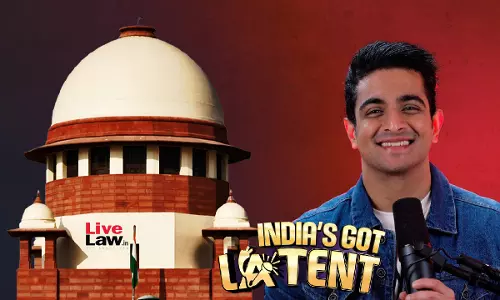
India's Got Latent Row | Supreme Court Allows Ranveer Allahabadia To Resume His Show With Standards Of 'Decency & Morality'
The Supreme Court on Monday (March 3) lifted the restriction imposed on YouTuber & Podcaster Ranveer Allahabadia on airing shows. The Court allowed him to resume his show "The Ranveer Show" subject to furnishing an undertaking that his own shows will maintain the standards of decency and morality, so that viewers of any age group can watch.The condition to not air any shows was imposed...
Supreme Court Grants Interim Bail 'On Trial Basis' To Ex-Civil Servants In Chhattisgarh Coal Levy Scam Case
The Supreme Court today (March 3) granted interim bail to ex-civil servants Saumya Chaurasia, Ranu Sahu and other accused persons in the Chhattisgarh Coal Levy Scam Case. The bench of Justice Surya Kant and Justice NK Singh was hearing the challenge to the order of the Chhattisgarh High Court dated November 4, 2024, which dismissed the bail applications of the petitioners. The Court...

'Notice To User Necessary Before Taking Down Social Media Content': Supreme Court Expresses Prima Facie View In PIL Challenging IT Rules
While hearing a PIL challenging the blocking of social media accounts/posts without issuing notice to the user ("originators") who uploaded the post, the Supreme Court on Monday (March 3) orally remarked that notice must be issued to users who are identifiable.A bench of Justices BR Gavai and AG Masih sought the response of the Union Government on the petition filed by Software Freedom Law...
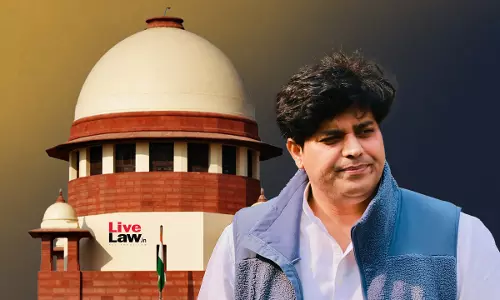
No Presumption Of Corruption Due To Misuse Of Authority If There's No Proof Of Demand & Acceptance Of Bribe: Supreme Court
The Supreme Court recently held that a mere allegation of misuse of authority will not give rise to a presumption under Section 20 of the Prevention of Corruption Act, 1988 (PC Act) unless there is proof of demand and acceptance of illegal gratification.Section 20 of the PC Act presumes that a public servant who accepts an undue advantage did so as a motive or reward. The Court ruled that...
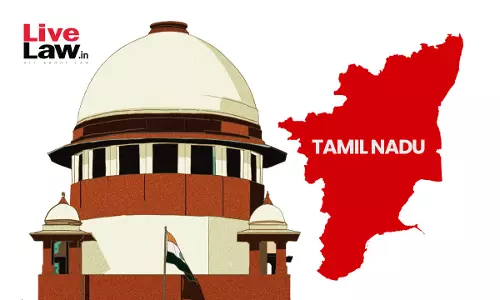
'Caste Certificate Seems To Be Big Problem In Tamil Nadu; There Appears To Be A Huge Racket' : Supreme Court
The Supreme Court recently made a prima facie observation regarding the existence of a "huge racket" in the State of Tamil Nadu which was behind issuing bogus caste certificates.The Court made this observation while dealing with a batch of cases concerning the certificates issued to thousands of persons certifying them to be belonging to the Hindu Konda Reddis Community in Tamil...

Complete Ban On Students Using Smartphones In Schools 'Undesirable': Delhi High Court Issues Guidelines For Regulated Use
The Delhi High Court has recently observed that a “complete ban” on use of smartphones by students attending school is both an “undesirable and unworkable” approach.Issuing guidelines on regulated use of smartphones by students in schools, Justice Anup Jairam Bhambhani said that as a matter of policy students should not be barred from carrying smartphones to school but such use must...
S. 378(3) CrPC | For Leave To Appeal, Consider If Prima Facie Case Or Arguable Points Exist; Not Whether Acquittal Likely To Be Reversed: Supreme Court
The Supreme Court recently clarified that when deciding an application for leave to appeal under Section 378(3) Cr.P.C. against an acquittal, the High Court should not deny leave solely based on a prima facie assessment of whether the acquittal would be overturned. Instead, it must apply its mind and determine whether a prima facie case exists or if arguable points have been...
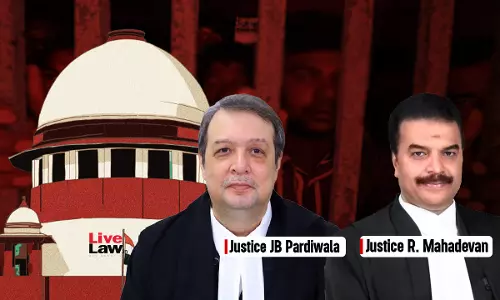

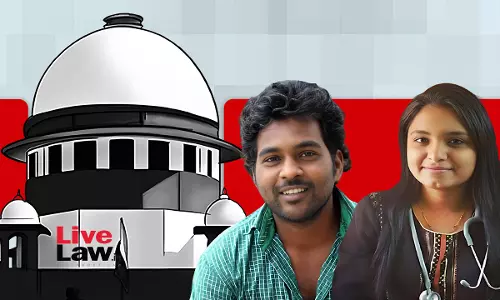
Caste Discrimination In Colleges | 'Draft Regulations Prepared By UGC', Tells Union; Supreme Court Mulls 'Strong & Robust' Mechanism
In the PIL assailing caste discrimination in higher educational institutions (HEIs), the Union recently told the Supreme Court that the University Grants Commission (UGC) has prepared draft regulations to inter-alia address the issues raised. On its part, the Court expressed that it is looking to create a "very strong and robust mechanism" for "really" tackling the unfortunate issues.A bench...
Arbitration Agreement Enforceable Against Legal Representatives Of Deceased Party : Supreme Court
The Supreme Court has reiterated that an arbitration agreement is enforceable against the legal representatives of a deceased partner of a partnership firm."An arbitration agreement does not cease to exist on the death of any party and the arbitration agreement can be enforced by or against the legal representatives of the deceased," the Court stated, referring to the judgment in Ravi...