


Tax

Income Tax Act | Offence Committed Before Show-Cause Notice Compoundable As Covered By 'First Offence' In Compounding Guidelines: Supreme Court
The Supreme Court on January 7 set aside the Gujarat High Court's judgment dated March 21, 2017, through which the rejection to the compounding application of the Appellant for the assessment year 2013-2014, for having filed the belated income tax return, was upheld on the ground that only for the "first offence" compounding of offence is possible. Since the Appellant had filed delayed income...
Not An Enabling Provision, Proscribes Reassessment Action Beyond Limitation: Delhi HC Explains Timelines U/S 149 Of Income Tax Act
The Delhi High Court has made it clear that Section 149 of the Income Tax Act, which prescribes a limitation period for initiating reassessment against an assessee, is not an enabling provision but rather a proscription on the Assessing Officer's powers.A division bench of Acting Chief Justice Vibhu Bakhru and Justice Tushar Rao Gedela observed,“The opening sentence of Section 149(1) of the...

Direct Tax Annual Digest 2024: Part II
Cash-In-Hand Out Of Business Profits Declared In Return U/s 44AD, Can't Be Plainly Added As Unexplained Money: Delhi ITATWhile allowing the appeal against the addition on account of unexplained money, the New Delhi ITAT held that if the assessee's contention is that it had turnover exceeding the limit u/s 44AD of the Income Tax Act, then CIT(A) ought to have acted in accordance with law....
Superannuation Fund | Limit On Deduction Of Employer's Contribution Applies To Initial/ Annual Contribution, Not Additional Payments: Delhi HC
The Delhi High Court has held that the limit prescribed under Section 36(1)(iv) of the Income Tax Act 1961, on deductions that an employer can seek for contributions made towards superannuation funds, applies only at the stage of setting up the fund or making ordinary annual payments.A division bench of Justices Yashwant Varma and Harish Vaidyanathan Shankar said any contribution...
Direct Tax Annual Digest 2024: Part I
ITAT Deletes Additions Against Unsuspecting Investor In A 'Penny Stock' To Make Quick ProfitThe Mumbai Bench of Income Tax Appellate Tribunal (ITAT) has held that the assessee was an unsuspecting investor who transacted in a 'penny stock' with a view to earning a quick profit, and since his involvement in any dubious transaction relating to price rigging or connection with exit providers...

Baggage Rules Apply Only To Luggage Of International Travellers, Not To 'Reasonable Amount' Of Jewellery Worn In-Person: Madras HC
The Madras High Court has made it clear that Baggage Rule, 2016 framed under the Customs Act, 1962 apply only to the baggage carried by an international traveller.Justice Krishnan Ramasamy observed that the Rules cannot be extended to articles like jewellery, “carried on the person” of a traveller.The bench observed, “The Customs Act, 1962, enables the Central Government to make Rules...

Notice Issued To Non-Existing Entity Post-Merger Is Substantive Illegality, Dept Cannot Cite Technical Glitch: Bombay High Court
The Bombay High Court stated that notice issued to a non-existing entity post-merger is a substantive illegality and not some procedural violation. “we cannot condone the fundamental error in issuing the impugned notices against a non-existing company despite full knowledge of the merger. The impugned notices, which are non-est cannot be treated as “good” as urged on behalf...
Adjustment Of Refund Against Confirmed Demand During Pendency Of Appeal Amounts To Coercive Recovery: CESTAT
The Chandigarh Bench of Customs, Excise, and Service Tax Appellate Tribunal (CESTAT) has stated that adjustment of refund against a confirmed demand during the pendency of an appeal amounts to coercive recovery. The amount adjusted from the total refund sanctioned to the assessee is refundable to the assessee at the rate of 12% per annum computed from the date of deposit till the date...
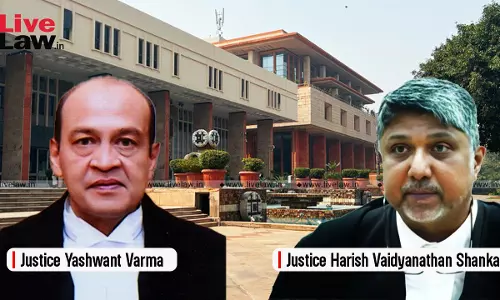
What Is The Time Period Surviving U/S 149 Of Income Tax Act For Issuing Reassessment Notices: Delhi High Court Explains
The Delhi High Court has interpreted the Supreme Court's decision in Union of India v. Rajeev Bansal to elucidate the time period surviving under Section 149 of the Income Tax Act, 1961 for issuing reassessment notices.A division bench of Justices Yashwant Varma and Harish Vaidyanathan Shankar concluded that the period between 20 March 2020 to 30 June 2021 would be excluded from limitation,...
Dept Cannot Consider Refund Claim Unless It Specifies Which Notification And Provision It Has Been Sought Under: CESTAT
The Ahmedabad Bench of Customs, Excise, and Service Tax Appellate Tribunal (CESTAT) has stated that the department cannot consider a refund claim unless it is specified under which notification and provision the same has been sought. The Bench of Somesh Arora (Judicial) has observed that, “The lapse of non-filing of refund under proper notification separately for June 2013 cannot...
Adobe India Is Not Dependent Agent PE Of Adobe Ireland: Delhi High Court Negates Attribution Of Further Profits
The Delhi High Court has upheld an order of the Income Tax Appellate Tribunal to the effect that Adobe Systems India Pvt. Ltd is not a dependent agent permanent establishment (DAPE) of Adobe Systems Software Ireland Ltd.In doing so, a division bench of Justices Yashwant Varma and Harish Vaidyanathan Shankar affirmed that no further attribution of profit can be made as Adobe India was...
Suo Moto Disallowance Made By Assessee Under Bonafide Belief Of Tax Liability Can Be Rectified U/S 264 Of Income Tax Act Without Amending ITR: Delhi HC
The Delhi High Court has held that an application for revision under Section 264 of the Income Tax Act, 1961 can be preferred by an assessee who makes suo motu disallowance in its Return of Income (RoI/ ITR), under a bonafide yet mistaken belief that the same was liable to be offered for taxation.A division bench of Justices Yashwant Varma and Harish Vaidyanathan Shankar added that the...