


Supreme court
Bail Condition That Accused Shall Furnish Bail Bonds 6 Months After Passing Of Order Can't Be Imposed : Supreme Court
The Supreme Court recently (October 24) dismissed two special leave petitions challenging the bail orders of the Patna High Court. It set aside the orders passed by the High Court and remitted the matter back to the High Court for a fresh hearing on merits, not before orally remarking that they have repeatedly witnessed bail orders passed by the High Court without assigning reasons.The...
Oral Dying Declaration Made To Close Relatives Requires Cautious Assessment Before Being Used To Convict Accused : Supreme Court
The Supreme Court observed that when the conviction was based on the deceased's oral dying declaration to a close relative, the courts must exercise due caution in believing the testimony of the close relative to convict the accused. The bench comprising Justice CT Ravikumar and Justice Sudhanshu Dhulia heard a case where the prosecution tried to prove the guilt of the accused based on the...
Employee In Supervisory Capacity, Drawing Wages Exceeding 10k Per Month Not 'Workman' Under Industrial Disputes Act: Supreme Court
The Supreme Court recently held that an employee did not come within the definition of "workman" under Section 2(s) of the Industrial Disputes Act, 1947 (as amended on 2010) because he was employed in a supervisory capacity and drew wages exceeding Rs. 1,600 (now Rs.10,000/- per month as per 2010 amendment). The Court applied the pre-amended provision since the employee's service was...
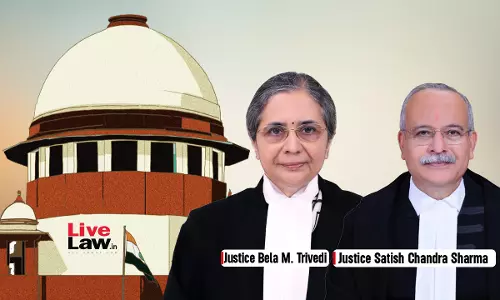
S.106 Evidence Act | Accused Has Duty To Offer Explanations When Offence Was Committed Within Privacy Of Their House : Supreme Court
The Supreme Court observed that when the offence was committed in the presence of the accused in the privacy of their house, then their failure to offer explanations can be treated as an adverse circumstance against them as per Section 106 of the Indian Evidence Act, 1872 (“IEA”).The bench comprising Justices Bela M. Trivedi and Satish Chandra Sharma heard a criminal appeal filed by...

Supreme Court Monthly Digest- August 2024 With Statute And Subject Wise Index
Ancient Monuments and Archaeological Sites and Remains Act, 1958Monument of national importance - Protection of a structure known as the Gumti - The petitioner challenged the dismissal of his writ petition by the Delhi High Court, which followed the Archaeological Survey of India's (ASI) report that changes made by the Defence Colony Welfare Association (DCWA) to the Gumti resulted in its loss...
S. 498A IPC | Courts Must Identify Instances Of Over Implication Of Persons In Cases & Avert Undue Suffering To Them: Supreme Court
Recently, the Supreme Court expressed dismay over the tendency to over-implicate the persons and to present an exaggerated version in Section 498-A IPC domestic cruelty cases. “We are of the view that in view of such circumstances, the courts have to be careful to identify instances of over implication and to avert the suffering of ignominy and inexpiable consequences, by such persons.”,...
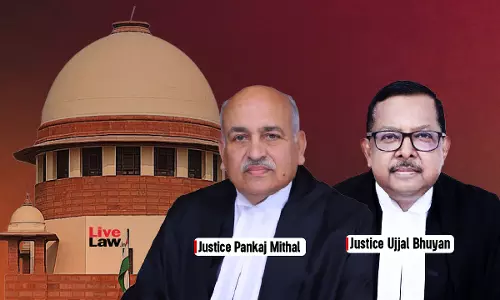
S. 126 TPA | Gift Deed Can't Be Revoked Ordinarily, More Particularly When No Right Of Revocation Is Reserved In Deed : Supreme Court
The Supreme Court observed that a gift deed could not be revoked ordinarily, especially when no right of revocation is reserved in the deed. The judgment also explained the conditions to revoke a gift deed as per Section 126 of the Transfer of Property Act,The bench comprising Justice Pankaj Mithal and Justice Ujjal Bhuyan said that when the gift deed was executed by the donor in favor of...

Impossible Condition To Deposit Money Shouldn't Be Imposed To Suspend Sentence : Supreme Court
The Supreme Court today (October 24) held that if a condition to deposit an amount imposed by the appellate court while suspending sentence of a convict is impossible for the appellant to comply with, it may defeat the right to appeal and violate appellant's right under Article 21 of the Constitution.“Whenever a prayer is for suspension of the sentence of fine, the Appellate Court must...
When Title Declaration Suit Seeks Possession Recovery Also, Limitation Period For Possession Recovery Applicable : Supreme Court
The Supreme Court observed that when along with a suit for declaration of title, a further relief is sought, the limitation period would be governed by the Article governing the suit for such further relief. In other words, the bench comprising Justice Pankaj Mithal and Justice Ujjal Bhuyan explained that if in a suit for declaration of title, a further relief of recovery of possession is...
Inherent Powers Under Rule 11 of NCLT Rules Cannot Be Used To Circumvent Procedure To Withdraw CIRP Under S.12A IBC & R. 30A: Supreme Court
The Supreme Court Bench led by CJI DY Chandrachud comprising Justices JB Pardiwala and Manoj Misra held that 'inherent powers' cannot be used to subvert legal provisions, which exhaustively provide for a procedure. To permit the NCLAT to circumvent this detailed procedure by invoking its inherent powers under Rule 11 would run contrary to the carefully crafted procedure for withdrawal. In...
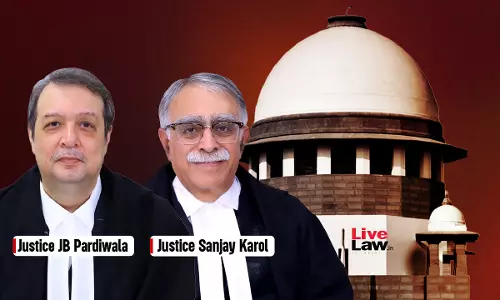
'Procedural Irregularity Can't Defeat Substantive Right': Supreme Court Sets Aside HC Order Dismissing Objections To Decree Due to Misapplication of Provisions
Observing that procedural irregularity cannot defeat substantive rights, the Supreme Court provided relief to the decree objector whose objection plea was refused by the High Court on the grounds of misapplication of the provisions in filing his objections towards execution of the decree. The case relates to the ascertainment of the right in a suit property where the first partition...

Aadhaar Card Not Suitable As Proof Of Date Of Birth : Supreme Court
The Supreme Court today set aside a High Court's decision to accept the date of birth mentioned in the Aadhaar Card to determine the age of the victim in a motor accident compensation case. The bench comprising Justices Sanjay Karol and Ujjal Bhuyan was not inclined to accept the suitability of the Aadhaar Card as proof of age. The Court observed that instead of referring to the date of...