


Supreme court
Second Suit On Same Cause Of Action Must Be Filed Within 3 Years Of Rejection Of Earlier Plaint : Supreme Court
The Supreme Court observed that the subsequent suit on the same cause of action would be barred by limitation if filed beyond three years after the rejection of an earlier plaint. The Court rejected the argument that Order VII Rule 13 of the Code of Civil Procedure (“CPC”) justifies filing a fresh suit after the rejection of the earlier plaint. Instead, the Court said the subsequent...

Frame Cashless Treatment Scheme For Road Accident Victims During 'Golden Hour' By March 14 : Supreme Court Directs Centre
The Supreme Court today (January 8) directed the Central Government to frame a scheme for cashless treatment for victims of motor vehicle accidents during the “golden hour”, the first hour after a traumatic injury when prompt medical care has the highest likelihood of preventing death by March 14, 2025.“Once the scheme is framed and its implementation starts, it will save the lives...
'Time He Lost Can't Be Restored' : Supreme Court Frees Prisoner After 25 Years, Finds He Was A Minor At The Time Of Offence
In a remarkable judgment, the Supreme Court on Wednesday (January 8) ordered the release of a prisoner, who has been under incarceration for nearly 25 years, after finding that he was a juvenile at the time of the offence in the year 1994.A bench comprising Justice MM Sundresh and Justice Aravind Kumar found that he was only 14 years old at the time of the commission of the offence.The...

'Land Meant For Poor Can't Be Commercially Exploited' : Supreme Court Sets Aside HC Direction To Convey Mumbai Plot To Pvt Company
The Supreme Court on Tuesday (January 7) set aside Bombay High Court's order directing the Municipal Corporation of Greater Mumbai (MCGM) to execute a formal conveyance deed in favour of Century Textiles and Industries Limited granting it ownership rights over approximately five acres land in Lower Parel.A bench of Justice Vikram Nath and Justice Prasanna B Varale allowed MCGM's appeal...
Domestic Violence Act Cases Have No Penal Consequence Except For Breach Of Protection Order: Supreme Court Criticises Issuance Of Bailable Warrants
The Supreme Court criticized the issuance of bailable warrant by a Magistrate in a cases under the Protection of Women from Domestic Violence Act, 2005The Court remarked that there is no justification for issuing bailable warrants in cases under the Domestic Violence Act as they are quasi-criminal proceedings and do not carry penal consequences unless a protection order is...
Vicarious Liability Of Company Directors/Officials Not Automatic; Specific Statutory Provision & Personal Involvement Needed : Supreme Court
The Supreme Court noted that directors/officials cannot be held vicariously liable for a company's illegal actions unless it is demonstrated that the official personally engaged in the conduct directly linking them to the company's liability, and such liability is supported by a specific statutory provision. “While a company may be held liable for the wrongful acts of its employees,...
SARFAESI | Borrower's Right Of Redemption Available Only Till Notice For Sale Of Mortgaged Asset Is Published : Supreme Court
The Supreme Court has stated that the right of a borrower to redeem the secured asset can be exercised only till a notice for the sale of the mortgaged property is published in terms of Rule 9(1) of the Security Interest (Enforcement) Rules, 2002.The Court observed that till the 2016 amendment to the Securitisation and Reconstruction of Financial Assets and Enforcement of Security Interest...
NDPS Act | Seized Vehicle Not Liable To Be Confiscated If Accused Used It Without Owner's Knowledge Or Connivance : Supreme Court
The Supreme Court ruled that a vehicle seized under the Narcotic Drugs and Psychotropic Substances Act for the alleged transport of drugs cannot be confiscated if the owner of the vehicle can prove that it was used by the accused person without the owner's knowledge or connivance“However, the seized vehicle is not liable to confiscation if the owner of the seized vehicle can prove that...
Sale By Way Of Public Auction Can't Be Set Aside Unless There's Material Irregularity Or Fraud/Collusion : Supreme Court
The Supreme Court has reiterated the principle that sale by way of public auction cannot be set aside until there is any material irregularity and/or illegality committed in holding the auction or if such auction was vitiated by any fraud or collusion. Reference was made to the judgment in V.S. Palanivel vs. P. Sriram 2024 LiveLaw (SC) 662 which held that unless there are some serious flaws...
Until Sale Deed Is Registered, Ownership Of Immovable Property Isn't Transferred : Supreme Court
The Supreme Court has reiterated that the ownership of an immovable property does not get transferred until the sale deed is registered. Mere transfer of possession and payment of consideration will not transfer ownership, unless the sale deed is registered.Referring to Section 54 of the Transfer of Property Act, 1882, a bench comprising Justice BV Nagarathna and Justice NK Singh observed...
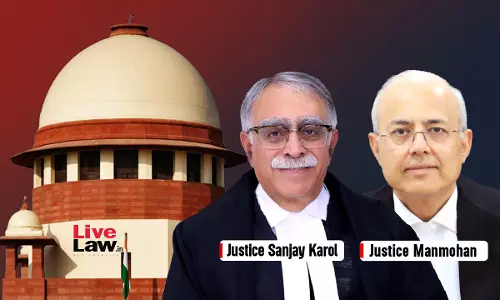
NDPS Act| When Can Owner Of Vehicle Used To Carry Contraband Be Arrayed As Accused? Supreme Court Explains
The Supreme Court today outlined four distinct scenarios that arise in cases involving the seizure of vehicles used to transport narcotic substances, as punishable under the Narcotic Drugs and Psychotropic Substances Act (NDPS Act).The bench comprising Justice Sanjay Karol and Justice Manmohan answered the possible fallouts of those scenarios i.e., whether there would be an interim release of...
Offence Of Grievous Hurt By Dangerous Weapons(S.326 IPC) Can Be Compromised In Exceptional Circumstances: Supreme Court
The Supreme Court (today on January 07) observed that while Section 326 (punishment for grievous hurt by dangerous weapons) of the Indian Penal Code, 1860, is non-compoundable, the Court can, in exceptional circumstances, invoke its inherent power to give effect to compromise. Such circumstance also includes voluntary settlement between the parties. “In light of the amicable settlement and...