


Supreme court
S. 80 CPC | Amendments To Plaint Linked To Main Cause Of Action Constitutes Continuous Of Action, No Notice Required To Government : Supreme Court
The Supreme Court observed that when an application seeking an amendment to plaint is filed due to subsequent developments intrinsically linked to the main cause of action, it constitutes a continuous cause of action, and no notice to the government is required under Section 80 of the Code of Civil Procedure, 1908 (CPC). The primary issue for consideration before the Court was whether a...
Though Normally Employers Insist On Experience Gained Post-Qualification, There Could Be Exceptions : Supreme Court
The Supreme Court observed that though employers normally insist on the experience gained after obtaining a particular qualification, there could be exceptions as well."Although, normally, experience gained after acquiring a particular qualification could justifiably be insisted upon by the employer, there could be exceptions," the Court observed.The observation was made while allowing...
Non-Recovery Of Crime Weapon Not Fatal To Prosecution Case If There Are Direct Reliable Witnesses : Supreme Court
The Supreme Court, in its judgment dated January 10, reiterated that the non-recovery of the weapon of crime is not fatal to the prosecution case, if there are direct reliable witnesses.Reliance was placed on Rakesh v. State of U.P., wherein the Court had previously held that for convicting an accused, recovery of the weapon used in the commission of an offence is not a sine qua non.The...
Supreme Court Flags Stringent Limitation Provisions Curtailing Arbitration Appeal Remedies, Urges Parliament To Address Issue
The Supreme Court raised concerns about the interpretation of limitation statutes in arbitration cases and observed that the rigid application of the law could curtail the limited remedy available under Section 34 of the Arbitration and Conciliation Act, 1996 to challenge arbitral awards.“In our view, the above construction of limitation statutes is quite stringent and unduly curtails a...
Convict Given Benefit Of Probation Won't Suffer Any Disqualification Due To Conviction : Supreme Court
The Supreme Court recently held that when a Court confirms a conviction but extends the benefit of probation on grounds of good conduct, it cannot deny the consequential benefit which is the removal of disqualification, if any, attached to the conviction. In the present case, the conviction was under Sections 399 and 402 of the Indian Penal Code, 1806 (IPC) along with Sections 3/25 and 4/25...
'Not Proper To Keep In Detention Camp For Indefinite Period' : Supreme Court Asks Union To Decide Nigerian's Citizenship Application
While refusing to interfere with the detention of a Nigerian national, the Supreme Court recently asked the Union Government to take a decision on his application seeking Indian citizenship within three months.The Court noted that the Nigerian national, who was found to have a bogus visa and involvement in offences, was married to an Indian womanThe Court refused to interfere with the judgment...
Can Unregistered MSMEs Avail Dispute Settlement Under S.18 MSMED Act? Supreme Court Refers To Larger Bench
The Supreme Court today (Jan. 10) observed that for invoking the payment dispute resolution mechanism under Section 18 of the Micro, Small and Medium Enterprises Development Act, 2006 (MSMED Act), it is not mandatory for the MSMEs to have prior registration under Section 8 of MSMED Act i.e., filing of an Entrepreneur's Memorandum.Rejecting the argument that only registered enterprises at the...
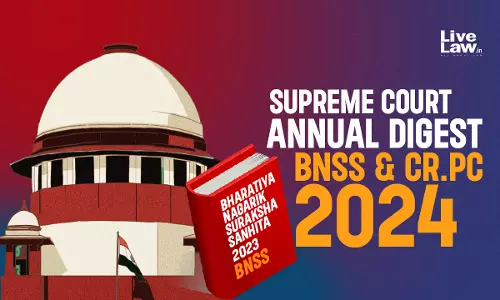
Supreme Court Annual Digest 2024: BNSS & Cr.PC
BHARATIYA NAGARIK SURAKSHA SANHITA, 2023 | SUPREME COURT ANNUAL DIGEST 2024CORRESPONDING CR.P.C. SECTIONS and COMPARISON SUMMARY of The BHARATIYA NAGARIK SURAKSHA SANHITA, 2023, (BNSS) and The CODE OF CRIMINAL PROCEDURE, 1973, (CrPC)Section 35 - When police may arrest without warrant[A new subsection 7 is added: “No arrest shall be made without prior permission of an officer not below the...
Land Earmarked For Public Purpose But Not Acquired Within Statutory Period : Supreme Court Upholds Original Owners' Right To Sell
The Supreme Court affirmed ownership rights of land purchasers over land in Thanjavur, Tamil Nadu which was designated for “public purpose” in a 1978 Layout Plan but no steps were taken by the planning authority or the state government to acquire it within the three-year statutory period mandated by the Tamil Nadu Town and Country Planning Act.Consequently, the land was deemed released...

IIT-JEE : Supreme Court Refuses To Review Reduction Of JEE(Advanced) Attempts; Allows Petitioners Who Dropped Out Between Nov 5-18 To Register
The Supreme Court today refused to interfere with the decision of the authorities to reduce the attempts for Joint Entrance Examination (Advanced) from three to two.At the same time, the Court granted relief to petitioners, who dropped out of their courses between November 5, 2024, and November 18, 2024, by allowing them to take part in the exam.The Court passed the order in a writ petition...
Knowledge About Sale Deed Can't Be Presumed From Date Of Its Registration; Limitation Period Starts From Date Of Knowledge : Supreme Court
While dealing with dismissal of a suit, seeking cancellation of a sale deed, on the ground of limitation, the Supreme Court recently reiterated that the period of limitation in such cases begins from the date when knowledge of fraud (underlying the challenged sale deed) is acquired, and not the date of registration."While the High Court came to the correct conclusion that under Article 59 of...