


Supreme court
Maintenance Proceedings Under S.125 CrPC Are Civil Proceedings Though Breach May Result In Penal Consequences: Supreme Court
The Supreme Court noted that maintenance proceedings under Section 125 of the Cr.P.C. are essentially civil in nature and should not be equated with criminal proceedings merely because they involve a penal consequence.“even if non-compliance with an order for payment of maintenance entails penal consequences, as may other decrees of a Civil Court, such proceedings would not qualify as or...
Specific Relief Act | Relinquishment Of Claims Under S.12(3) For Part Performance Can Be Made At Any Stage Of Litigation : Supreme Court
The Supreme Court observed that while seeking a part performance of the contract under Section 12(3) of the Specific Relief Act, 1963, the plea regarding the relinquishment of claims regarding the remaining part of the contract and all rights to compensation can be made at any stage of litigation,including the Appellate Stage. “we may only say that the relinquishment of claim to...
Principles To Evaluate Circumstantial Evidence In Criminal Cases : Supreme Court Explains
In a recent judgment, the Supreme Court enunciated the principles that courts must adhere to while appreciating and evaluating evidence in cases based on circumstantial evidence.While dismissing the appeal against the conviction in a rape-murder case, a bench comprising Justice BR Gavai, Justice KV Viswanathan and Justice Sandeep Mehta summarised the principles as follows :(i)The testimony...
'Prosecutrix's Testimony Doesn't Inspire Confidence' : Supreme Court Affirms Acquittal In Rape Case
The Supreme Court (on January 07), observed that in rape cases if a conviction is based on the sole evidence of a single witness, even that of the victim herself, such evidence should inspire confidence in the Court. The Court agreed that while the victim's statement is given a very high value, the Court must carefully examine the same. “Although it is absolutely true that in...
Know The Law | When Can Part Performance Of Contract Be Allowed As Per Section 12(3) Specific Relief Act?
The Supreme Court ruled that part performance of the contract under Section 12(3) of the Specific Relief Act, 1963 (“SRA”) cannot be claimed when the unperformed portion is substantial and non-segregable, and the plaintiff neither relinquishes claims for the unperformed part or damages nor shows readiness to perform the contract. As per Section 12(3) of the SRA, for claiming a...

Motor Accident Claim | Third Party Insurance Policy Effective From Date & Time Specified In Policy Document : Supreme Court
While dismissing an insurance company's appeal against a motor accident compensation award, the Supreme Court recently reiterated that merely alleging fraud as regards obtaining of an insurance policy is not enough. Rather, it has to be proved by the insurance company by adducing evidence. The Court further observed that policy coverage commences from the time and date specified in the...
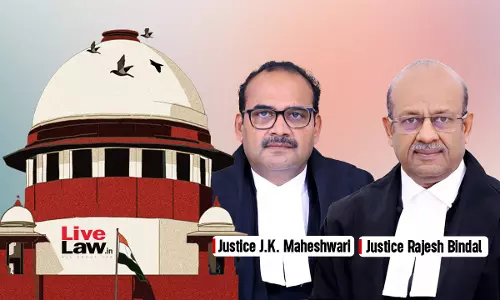
'Right To Access Justice Not Absolute' : Supreme Court Imposes Rs 1 Lakh Cost On Litigant For Multiple Frivolous Cases
The Supreme Court recently imposed a heavy cost of Rs.1,00,000 on the petitioner, who over the span of more than 11 years filed frivolous litigants and indulged in forum shopping more than 10 times including before the High Court of Bombay and the Supreme Court.A bench of Justices J.K. Maheshwari and Rajesh Bindal while upholding the right of the litigants to access the courts as the...

Propounder Taking Prominent Part In Will's Execution & Getting Substantial Benefit Raises Suspicions, Must Be Dispelled: Supreme Court
The Supreme Court ruled that a propounder who substantially benefits from a Will and participates in its execution raises suspicion, which must be dispelled with clear evidence. The propounder is expected to testify about the proper execution, the presence of attesting witnesses, and other key details. The Court further held that under Section 68 of the Indian Evidence Act, 1872, presenting...
Supreme Court Annual Digest 2024 - Constitution Of India
Constitution of IndiaArticle 8 - The Court clarified that when a person acquires a foreign citizenship, the cessation of Indian citizenship happens by operation of law by virtue of Section 9 of the Citizenship Act. Hence, such cessation of citizenship cannot be regarded as voluntary. Therefore, children of such persons cannot seek to resume Indian citizenship under Section 8(2) of the...
Know The Law | Why Supreme Court Frowned Upon Preferential Allotment Of Public Lands To Legislators, Civil Servants, Judges, Professionals Etc
The Supreme Court in its recent decision in State of Andhra Pradesh v. Dr Rao VBJ Chelikani , while quashing the preferential allotment of lands to the housing societies of MPs, MLAs, civil servants, Judges, defence personnel, journalists etc, dissected the important parameters in determining arbitrariness in legal challenges under Article 14. Here is a breakdown of CJI Sanjiv Khanna's...
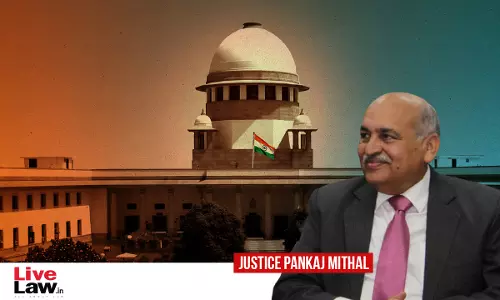
Supreme Court Calls For Uniform Limitation Periods Across Statutes, Greater Flexibility To Courts For Condoning Delays
The Supreme Court in a judgment authored by Justice Pankaj Mithal called for legislative reforms to ensure uniform limitation periods across statutes, enabling courts to condone delays beyond rigid limits in cases where sufficient cause is shown.“In my personal opinion, the statutes ought not to provide different period of limitation for instituting suit, preferring appeal and making...