

Supreme court
Indian Military Nursing Service Personnel Eligible For Civil Posts Under Ex-Servicemen Quota In Punjab : Supreme Court
The Supreme Court on Wednesday (April 16) held that the personnel from the Indian Military Nursing Service (IMNS) qualify as "ex-servicemen" under the Punjab Recruitment of Ex-Servicemen Rules, 1982 (“1982 Rules”) for reservation in Punjab Civil Services. The Court noted that the 1982 Rules aim to resettle veterans, given the fact that 7.7% of Army personnel are from Punjab and...
Supreme Court Weekly Round-up: April 07, 2025 to April 13, 2025
Nominal IndexCitationsKarandeep Sharma @ Razia @ Raju v. State of Uttarakhand 2025 LiveLaw (SC) 398G.C. Manjunath & Ors. v. Seetaram 2025 LiveLaw (SC) 399Amritpal Jagmohan Sethi v. Haribhau Pundlik Ingole 2025 LiveLaw (SC) 400Securities and Exchange Board of India v. Ram Kishori Gupta & Anr. 2025 LiveLaw (SC) 401K. Gopi v. Sub-Registrar & Ors. 2025 LiveLaw (SC) 402Sohom Shipping...
Writ Petition Under Article 32 Cannot Be Used To Challenge Our Own Judgments : Supreme Court
The Supreme Court today (April 16) ruled that Article 32 of the Constitution, being a remedial provision for the enforcement of fundamental rights, cannot be invoked as a means to challenge the Court's own judgment. The Court noted that allowing writ petitions under Article 32 to challenge final judgments would undermine judicial hierarchy and lead to endless litigation, undermining...
Courts & SROs Must Report To Income Tax Authorities If Suits/Deeds Mention Cash Transactions Above ₹2 Lakh: Supreme Court
In a significant ruling aimed at combating black money and tax evasion, the Supreme Court today (April 16) directed courts and registration authorities to report cash transactions exceeding ₹2 lakhs to the Income Tax Department. The Court ruled that whenever any suit is filed claiming that a consideration of Rs. 2 Lacs or above is paid towards a transaction, then it becomes obligatory upon...
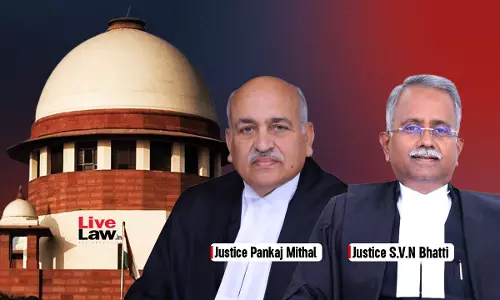
If Primary Relief Is Time-Barred, Ancillary Reliefs Also Become Unenforceable : Supreme Court
The Supreme Court observed that when the primary relief in the suit becomes time-barred then the ancillary relief claimed therein also becomes unenforceable. The bench comprising Justices Pankaj Mithal and SVN Bhatti heard the case where the primary relief in a plaintiff's suit seeking a declaration that his father's Will and Codicil was null and void was dismissed by the civil court...

Art. 58 Limitation Act | Limitation Period Begins When Cause Of Action First Arises, Not On Full Knowledge Of Dispute : Supreme Court
The Supreme Court observed that the limitation period starts from the date when the cause of action first accrued to the plaintiff, and not when he acquired 'full knowledge' about the same. It is a settled law that time-barred suits must be dismissed even if the limitation is not pleaded as a defence. An argument was made that the limitation period begins not from the date the first cause...
Supreme Court Lays Down Twin Test To Resolve Copyright–Design Conflict Under S15(2) Of Copyright Act
The Supreme Court today (April 15) resolved an ambiguity under the intellectual property (IP) law, by resolving the overlap between 'design' and 'copyright' protection under Section 15(2) of the Copyright Act. Section 15(2) of the Copyright Act specifically deals with designs capable of being registered under the Designs Act, 2000, and the limit of copyright protection in such cases....
'Order Taking Cognizance Of PMLA Complaint Quashed' : Supreme Court Grants Bail To Ex-IAS Officer In Chhattisgarh Liquor Scam
The Supreme Court today (April 15) granted bail to former IAS officer Anil Tuteja in a money laundering case arising out of the alleged Chhattisgarh liquor scam, noting that the order of trial court taking cognizance of the money laundering case has been set aside.A bench of Justice Abhay S Oka and Justice Ujjal Bhuyan observed that the principles laid down in V. Senthil Balaji v. Deputy...