


Supreme court
S.319 CrPC Summoning Order Can't Be Quashed Based On Alibi Evidence Of Additional Accused : Supreme Court
The Supreme Court held that to summon an additional accused under Section 319 of the Cr.P.C., it is not necessary to establish guilt beyond a reasonable doubt; a person may be summoned if there is prima facie evidence indicating their involvement in the offence. “Indeed, it is difficult to conceive of what stronger material could be demanded at the summoning stage short of a confession....

S. 61(2) IBC | Appeal Filed Beyond 45 Days Not Condonable By NCLAT : Supreme Court
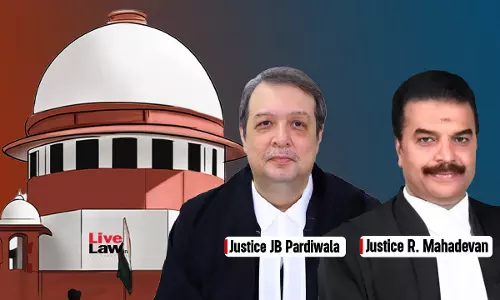
The Supreme Court today (May 7) ruled that the National Company Law Appellate Tribunal (NCLAT), acting as the Adjudicating Authority under the Insolvency and Bankruptcy Code, 2016 (Code), has no power to condone delays in filing appeals beyond the prescribed limit of 45 (30+15) days under Section 61(2) of the Code. Accordingly, the bench of Justices JB Pardiwala and R Mahadevan set aside...




Supreme Court Directs NCR States To Issue Directions Under S.5 Environment Protection Act To Enforce Firecrackers' Ban
The Supreme Court on Tuesday directed the states of Uttar Pradesh, Rajasthan and Haryana to issue directions under Section 5 of the Environment Protection Act, 1986, enforcing a complete ban on firecrackers in the National Capital Region (NCR). A bench of Justice Abhay S. Oka and Justice Ujjal Bhuyan was hearing the MC Mehta matter concerning air pollution in Delhi NCR from various sources...
Dispute Over Full & Final Settlement Is Arbitrable Despite Parties Discharging Contract : Supreme Court
The Supreme Court today (May 6) observed that if the insured alleges coercion in arriving at a settlement with the insurer, then the dispute over the validity of the settlement remains arbitrable. “Any dispute pertaining to the full and final settlement itself by necessary implication being a dispute arising out of or in relation to or under the substantive contract would not be precluded...
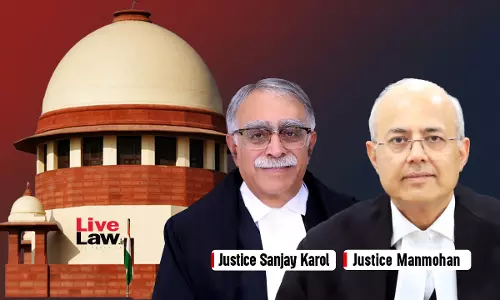
Suits Can Be Dismissed Suo Motu Under Order XII Rule 6 CPC Based On Plaintiff's Admissions : Supreme Court
The Supreme Court today (May 6) ruled that under Order XII Rule 6 of the CPC, a court may not only pass a decree in the plaintiff's favour based on the defendant's admissions but may also dismiss a suit where the plaintiff's admissions undermine the claim. Relying on the recent case of Rajiv Ghosh v. Satya Narayan Jaiswal, the bench comprising Justices Sanjay Karol and Manmohan affirmed that...

Mere Performance Of Another Religious Ritual Doesn't Mean Giving Up Of One's Own Religion : Supreme Court
The Supreme Court today(May 6) set aside the Kerala High Court's judgment which annulled the election of CPI(M) MLA A Raja in the 2021 Legislative Assembly elections.A bench comprising Justice AS Oka and Justice Ahsanuddin Amanullah allowed the appeal filed by Raja against the the March 23, 2023 order of the Kerala High Court which annulled his elections on ground that he was not a member of...
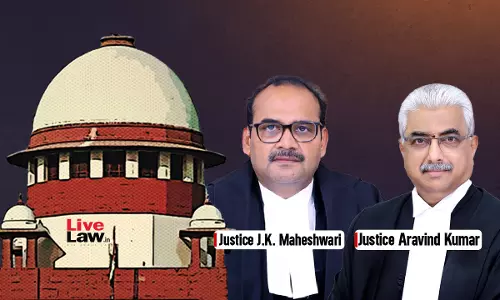
Appeals To Restore Death Penalty Don't Require 3-Judge Bench Hearing : Supreme Court Rejects Godhra Case Convicts' Objections
The Supreme Court today(May 6) began the final hearing of the 2018 appeals pending in the 2002 Godhra train burning case. The criminal appeals, filed by the convicts challenging their conviction and the State of Gujarat seeking death sentence for the convicts, were listed before a bench of Justice J.K. Maheshwari and Justice Aravind Kumar. At the outset, Senior Advocate Sanjay Hegde, for...
Order XVIII Rule 17 CPC | Power To Recall Witness Vests With Court, Parties Cannot Do Without Court's Leave : Supreme Court
The Supreme Court held that Order XVIII Rule 17 of the CPC empowers the court to recall a witness at any stage solely for the purpose of seeking clarification, but it does not grant any right to the parties to recall witnesses for further examination or cross-examination. The Court further clarified that the power under Order XVIII Rule 17 should be exercised strictly to remove ambiguities...

Supreme Court Sets Aside Kerala HC Judgment Which Anulled Election Of CPI(M) MLA A Raja
The Supreme Court today(May 6) set aside the Kerala High Court's judgment, which set aside the election of CPI(M) MLA A Raja in the 2021 Legislative Assembly elections.A bench comprising Justice AS Oka and Justice Ahsanuddin Amanullah allowed the appeal filed by Raja against the the March 23, 2023 order of the Kerala High Court which annulled his elections on ground that he was not a member...