


Articles

Reimagining Insolvency Resolution: Reverse CIRP A Game-Changer For India’s Real Estate Sector
The real estate industry is one of the thriving sectors in the modern business world. There are three parties in the real estate business – the real estate companies and their promoters (who develop the properties), the homebuyers (who purchase the flats/ apartments by engaging with the real estate developers), and the financial institutions (banks and other forms of non-financial institutions). When a real estate developer defaults on the repayment of debts, the financial institutions...
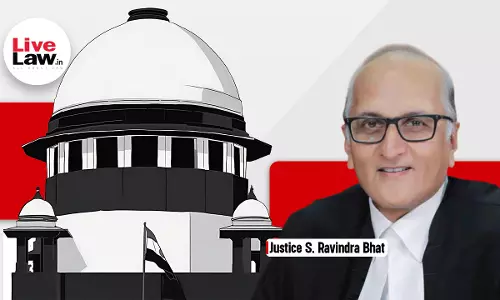
Justice Ravindra Bhat's Scholarly Legacy : A Look At His Important Judgments
“Fraternity is not the assimilation of the minority into the majority. To the contrary, it is the celebration of peaceful coexistence of differences that constitutes our national identity." - Justice Ravindra Bhat at a public lecture.In the world of jurisprudence, there exist those who simply interpret the law, and then there are those exceptional few who redefine it. Justice Ravindra Bhat, who recently retired from the Supreme Court on October 20, 2023, undoubtedly belongs to the latter...

Sex Workers, Their Adult Dependants, And Conflicting Laws
The Supreme Court of India in Budhadev Karmaskar vs State of West Bengal[1] held that prostitutes also have a right to live with dignity under Article 21 of the Constitution of India since they are also human beings and their problems also need to be addressed. Thereafter in 2022, in Budhadev Karmaskar v. State of West Bengal and Others[2] held that the “basic protection of human decency and dignity extends to sex workers and their children, who, bearing the brunt of social stigma attached to...
Equality Marriage Verdict: A Damper on the Century old Social Movement
The Indian Supreme Court passionately decriminalized the sex by same-sex partners in the Navtej Singh Johar Case and it upheld the constitutional rights of Non-heterosexuals or Queer or lesbians, gay bisexuals and transgender (LGBT) to cohabit as part of their privacy rights guaranteed by the Constitution of India. However, the apex court quietly backed out in the Marriage Equality Case in Supriyo Case[1] giving short shrift to the demand of LGBTs for a mere stamp of recognition for ...

How Laws Are Made In India
Recently Parliament has introduced the 3 Bills in Criminal Major Acts ; Bharatiya Nyay Sanhita Bills to( replace CRPC), Bhartiya Nagrik Suraksha Sanhita Bills to ( replace IPC) and Bhartiya Sakshya Bill to (replace Evidence Act) in August 2023. Women Reservation Bills 2023 (106 Constitutional Amendment Bill)have also received presidential assent. It is thus important to know how Parliament brings new laws and amend existing laws either in any Statute or in the Constitution itself. ...
Why The BCI Should Reconsider The Rules Governing The Provision Of A Scribe And ‘Extra Time’ For Pwd Applicants In AIBE-XVIII ?
Earlier today, the Bar Council of India (BCI)released a revised schedule for the All India Bar Examination (AIBE)-XVIII, postponing the exam to 26th November 2023. To practice law in courts and tribunals of India, one has to clear the AIBE, conducted biannually, within 2 years of their provisional enrolment with a State Bar Council. With every subsequent edition of the exam, the BCI has been consistently fine-tuning the mode and method in which it is conducted. However, in certain...

War For Talent – Antitrust & Collusion In The Labour Market
No-poach agreements (NPAs) are an emerging trend in global antitrust policy. It’s an agreement between employers to restrict hiring each other’s employees. In 2015 in the US, top tech companies Apple, Google, Intel Corp, and Adobe Systems Inc settled for $415 million payout to resolve an antitrust class action accusing them of conspiring to avoid cold calling each other’s employees. In 2019 and 2021, Duke University agreed to pay $73.5 million to settle claims that the institution had...

Safe Harbor: Bridge To Innovation Amidst The Waters Of Liability?
Today internet has become an integral part of our daily lives, and the concept of safe harbour provisions has emerged as a critical legal framework. These provisions aim to strike a delicate balance between fostering innovation and holding online platforms accountable for the content they host. Different jurisdictions around the world have adopted varying approaches to safe harbour provisions, reflecting their unique legal, cultural, and economic contexts. Safe harbour provisions are...

Speedy Justice And Lengthy Delays, The Arbitration Process
Through the decades, it has been witnessed that Arbitration carries a huge possibility for delays either due to the court’s procedural interference or due to non-compliance with the limitation periods specified under the Act. However, the real paradox arises in the post-arbitral award stage. This is because often when a party is dissatisfied with the final award and approaches the court to set it aside under Section 34 of the Arbitration Act, procedural fallacies seemingly undermine the...

Article 20 (3) & Test Identification Parade: The Question Of Rights And Obligations
The Supreme Court of India recently in a judgment[1] passed by it has delved into whether Test Identification Parade is violation of fundamental rights bestowed upon an accused under Article 20 (3) of the Constitution. Article 20 (3) of the Constitution provides that “No person accused of any offence shall be compelled to be a witness against himself”. The right guaranteed under Article 20 (3) acts as a “protective umbrella against testimonial compulsion in respect of persons accused of an...

Doctrine Of Frustration
Frustration is a helplessness arising from impossibility. The doctrine of frustration therefore discharges parties from their obligation to perform a contract when a contract is hit by an event that makes its performance impossible. Even though, the semantic meaning appears simple, it has become a complex subject because of a thin line of distinction between several concepts such as the impossibility of performance governed by the conditional contract; the impossibility of performance...

Remission Granted Or Not Granted: Crossing The ‘Laxman Rekha’
‘Clemency’ refers to the act of showing mercy or leniency to individuals who have been convicted of crimes. This can be in the form of a pardon, reprieve, commutation, or remission of their sentences. ‘Remission’ generally refers to the reduction or mitigation of a sentence that has been imposed on a person who has been convicted of a crime and allows for the reduction of the period of imprisonment or other penalties based on numerous factors and considerations in other words, without...