


Articles

Legitimization Of Cryptocurrency? Looking At Recent Indian Crypto Tax Saga
Bitcoin, Ethereum, Dogecoin, I am sure you might have heard about them, from a crypto fan or an ordinary fiat-currency lover, everyone is buzzing on the cryptos. Have you loved financial freedom, no institution on your top, no issue of counterfeiting, blazing fast global transfers with absolute anonymity, if you have answered any of the questions as a YES, then cryptocurrencies would come to your benefit. What exactly is a crypto? It is a digital asset-currency, working decentralized,...
Invoking International Law Language In Indian Diplomacy
"Lawfare" has been emerging as an argument among international law scholars in India; whether it is to enhance the study and usage of international law or to call out China's blatant violations of international law at the Indian borders. Lawfare means "the strategy of using – or misusing – law as a substitute for traditional military means to achieve an operational objective." It is a compound of the words law and warfare, which posited that it substitutes war, and harm is made with...

Comparative Analysis Of Product Liability In India With Developed Countries
India is a custom-based law country; courts follow the principles of justice, equity, and good conscience and those of tort law, such as the duty of care, negligence, and strict liability. India is gradually realising the importance of strengthening and enforcing a strict product liability regime to protect the rights of its consumers against the supply of defective materials by manufacturers and suppliers, which will also aid in protecting the interests of consumers. The Indian Ministry...

Freedom Of Contract And Interest Barring Clauses: Does Section 31(7)(A) Of The Arbitration Act Need A New Approach?
The Hon'ble High Court at New Delhi recently in the case of Patel Engineering Limited vs. UOI & Ors. has issued a notice to the Union of India and NTPC limited in a plea challenging the constitutional validity of Section 31(7)(a) of the Arbitration and Conciliation Act, 1996 (hereinafter referred to as "Act") and section 3(3)(a)(ii) of the Interest Act, 1978. It is because of the fact that most government or Public Sector Unit (PSU's) contracts are wedged with an 'interest barring'...
![Hjab Ban In Educational Institutions :A Constitutional Assessment [Research Brief By Academicians]](https://www.livelaw.in/h-upload/2022/02/17/500x300_409925-hijab-ban-karnataka-hc.jpg "Hjab Ban In Educational Institutions :A Constitutional Assessment [Research Brief By Academicians]")
Hjab Ban In Educational Institutions :A Constitutional Assessment [Research Brief By Academicians]
The hijab ban in Karnataka's schools and colleges has been a matter of public debate for some time now. The judgment in Resham v. State of Karnataka - where the Karnataka High Court dismissed the writ petitions filed by students against the Government Order and the decisions of educational institutions banning the hijab and other religious clothing/symbols in schools and colleges - has raised further issues concerns that require serious and considered engagement. This research brief has been...
Exception To DRT's Jurisdiction- Is Mardia Chemicals Still Relevant?
Section 34 of the Securitization and Reconstruction of Financial Assets and Enforcement of Security Interest Act, 2002 (SARFAESI Act) bars a Civil Court from entertaining any suit or proceeding in respect of any matter which a Debts Recovery Tribunal (DRT) or the Appellate Tribunal is empowered by or under the SARFAESI Act. While testing the validity of the SARFAESI Act, the Hon'ble Supreme Court had, in the case of Mardia Chemicals[1], carved out a limited exception to the Section 34 of...
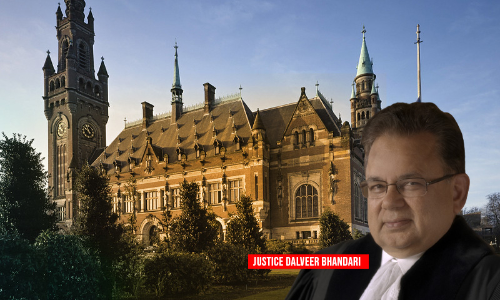
Why Justice Dalveer Bhandari's Vote At ICJ Should Not Be Linked To India's Position On Russia-Ukraine Conflict?
The International Court of Justice (ICJ) at the Hague, Netherlands, on Wednesday directed Russia to immediately halt its military operations in Ukraine in a 13-2 judgement with India's nominee at the ICJ Justice Dalveer Bhandari joining the majority. Justice Bhandari's vote in favour of indication of provisional measures against Russia has been perceived by few to be in conflict with India's official stance at the United Nations (UN) regarding the ongoing Ukraine-Russia conflict. India has...
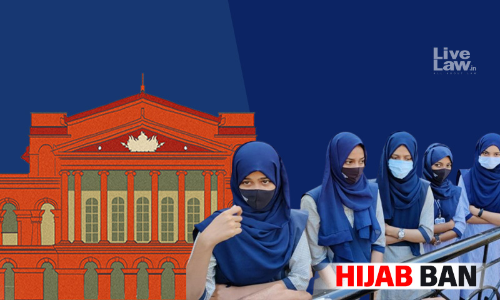
Hijab Verdict : How Preconceived Notions May Have Trumped Judicial Reasoning
The judgment of the Karnataka High Court upholding the hijab ban in classrooms, after declaring the wearing of the headscarf by Muslim women as not an essential practice of Islam, is being hotly debated. The judgment in the case Resham v State of Karnataka delivered by a bench comprising Chief Justice Ritu Raj Awasthi, Justice Krishna S Dixit and Justice JM Khazi shows the absurdities of the deeply problematic "Essential Religious Practice" doctrine, which is now being revisited by a...

The 'Survey'cal Strike (Introspection Into Section 4(1A) The Wakf Act 1995)
Wakf properties across the Country constitute a land bank second only to the Railways. The same are in the nature of permanent dedication for religious and charitable purposes. Statutory provisions contained in the 1954 and 1995 Wakf Acts provided for a survey of all Wakf properties. The Statement of Object & Reasons of an Amending Act [Amendment 27 of 2013] specifically indicated inadequacy of data of Wakf properties. This was only due to the omission in Section 4(1) of the...

The Judicial 'Shifting Sands' In Transnational Parental Abduction
11-year-old Z's[1] interim custody was granted by an Indian Family Court to his father, Perry, a Kenyan national. Z was born in India and lived in Delhi for a large part of his life with his mother, Smriti. The Indian Family Court considered Z's future prospects and being persuaded by the fact that he was the heir apparent to the vast business empire of his father, the Court held that it would be in Z's best interest to live with his father. Smriti was allowed visitation rights and Z's ...
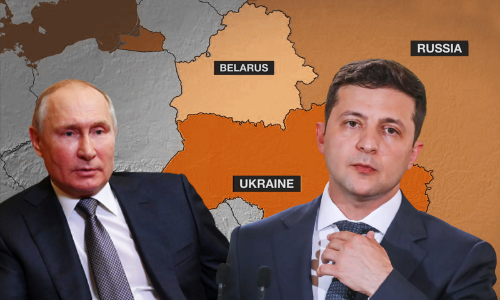
Russia's Aggression Against Ukraine: Explaining International Criminal Court's Jurisdiction
On 24 February 2022, even as the UN Security Council held emergency meetings to try and resolve ongoing tensions between Russia and Ukraine, Russia launched a military invasion into Ukraine. This blatant violation of international law has been rightfully met with widespread condemnation from the international community. It has also been met with hyperbolic claims suggesting that this invasion marks the "death of international law". Amidst all this however, Ukraine has filed claims against Russia...
A Thorough Look Into The Various Facets Of Cheating
Chapter 17 of the Indian Penal Code (IPC) titled as offences against property ( sections 415 to 420) deals with provisions relating to cheating. Section 415 of the I.P.C is the definition of cheating; the general punishment for which is contained in section 417 of the I.P.C. Section 416 of the I.P.C. defines what cheatingIndian Penal Code (IPC) by personation is. Aggravated forms of cheating are punishable under sections 418, 419 and...