


Articles
Application Of Section 14 Of Limitation Act In Income Tax Proceedings
Most rights are subject to limitations that are necessary and reasonable in a democratic society for the realization of certain common goods such as social justice, public order and effective government or for the protection of the rights of others. The limitation is either engrained in the statute itself or in case no limitation is prescribed, resort can be had to the Law of Limitation, 1963. The Law of Limitation is a procedural law which is founded on public policy. It is based on the...

Government Contracts, Arbitration And Clause Barring Grant Of Interest
Recent decision of Supreme Court in the case of Union of India vs Manraj Enterprises[1] rendered by Division Bench has held impliedly that the previous decision of co-ordinate Bench in Union of India vs Pradeep Vinod Constructions[2] is not a good law for not considering the three Judge Bench decision in Union of India vs Bright Power Projects (India) (P) Ltd[3] and also for being contrary to what was held subsequently by another three Judge Bench in the case of Jaiprakash Associates Ltd...
Power Of The "N.I.A. Special Court" To Tender Pardon To An Accomplice
CONTENTS Heading I N N E R T I T L E S PARA NO A Introduction 1 B N.I.A Courts are Courts of Session 2 C N.I.A Courts to follow Sessions Procedure 4 D D.1. D.2. Procedure to be followed for tendering pardon in a case triable exclusively by a Court of Session Pre-commitment pardon in a case...

Of Queerness, Inadequate Gestures And Private Members' Bills
"God save us from people who mean well." ― Vikram Seth, A Suitable Boy Introduction On 9th August 1970, the President of India assented to The Supreme Court (Enlargement of Criminal Appellate Jurisdiction) Bill, 1968 to enlarge the appellate jurisdiction of the Supreme Court in criminal matters. This would have been an ordinary occurrence usually, but what made it stand out was that it was tabled by the Urdu poet and a former judge of the Allahabad High Court, Anand Narain Mulla, a...

Post Abolishment Of Intellectual Property Appellate Board; A Re-Look At Section 124 Of The Trade Marks Act, 1999
Recently, the Tribunal Reforms Act, 2021 abolished various Tribunals including India's Intellectual Property Appellate Board (IPAB) and assigned their functions to the country's Commercial Courts and High Courts. Consequently, the Delhi High Court on 24th February, 2022, issued a public notice containing the finalized rules of procedure for its Intellectual Property Rights Division, in exercise of its powers under the Delhi High Court Act, 1966, the Code of Civil Procedure, 1908, and...
Blanket Forbearance From Modifying An Arbitral Award – How Far Justiciable?
Non-interference of courts, except to the extent of supervision, is the spinal cord of arbitration legislations across the jurisdictions. However, the difference between interference and supervision is often differentiated by a thin line. One such occasion raising the question of whether an indulgence of the court is supervision or interference arises while answering the question of whether the court while entertaining an application for setting aside an arbitral award has the power to...
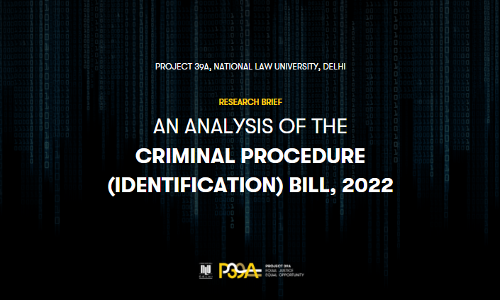
Criminal Procedure (Identification) Bill Problematic : Project 39A Report
On March 28, 2022, the Criminal Procedure (Identification) Bill, 2022 ('Bill') was tabled in the Lok Sabha. The Bill seeks to create a framework that allows the collection of certain 'measurements' by police or prison officers. The term 'measurements' has been defined to include a wide range of sensitive personal information like finger, palm and foot impressions, iris and retina scans, biological samples, and behavioural attributes. The Bill allows for the measurements and their records to be...
National Company Law Tribunals; Reeling Under Poor Infrastructure
The National Company Law Tribunals (NCLT) were constituted in 2016 for adjudication of matters arising out of the Companies Act, 2013, and exclusive jurisdiction under the Companies Act was vested with the NCLTs. After the enactment of the Insolvency and Bankruptcy Code, 2016 in December 2016, NCLT has been vested with exclusive jurisdiction to deal with cases arising out of IBC. However, like any other tribunal, NCLTs have also received indifferent treatment from the government and...
Shadow Of Unconstitutionality On DMC Amendment Bill 2022
The union government is in a mood to bring about a drastic change in political landscape of the Delhi. If dragged to court once passed, there are several legal nuances which might be interpreted, but that's up to the court to decide. Let us have a look and understanding of what provisions and basic features are in discussion to oppose or defend the bill, introduced in the Lok Sabha on 25th March, 2022 by Minister of State for Home, Shri Nityanand Rai. The Delhi Municipal Corporation...

Courts And The Sexual Minorities: Transgender Day Of Visibility 2022
Back in 2009, Rachel Crandall (a US based transgender activist) took the initiative and since then March 31 is celebrated as International Transgender Day of Visibility. Sexual minorities all over the world have been facing stigma, discrimination and oppression but with time we saw how things are getting better with rising awareness amongst the citizens and judicial intervention. In India, the National Legal Services Authority v. Union of India ("NALSA judgment") was the first ...

Delay In Release After The Bail Order
Today, the Chief Justice of India, Justice N.V. Ramana, has launched "Fast and Secure Transmission of Electronic Court Laws (FASTER)", a software developed to transmit court orders swiftly and securely. This was in response to the newspaper reports regarding prisoners not being released immediately even after the supreme court granting them bail for various reasons. It is not clear whether the system is created only for transmitting the bail orders passed by the supreme court or for the...
The Corporate Democracy And Demarcation Of Powers Of NCLT & Civil Courts
The recent developments appear to suggest that Invesco, one of the investors of Zee, has decided to withdraw its requisition notice which sought the removal of MD and CEO Mr. Punit Goenka from Board of Directors ("Board") of Zee. Though the withdrawal might end the dispute, the Order of the Division Bench of the Hon'ble Bombay High Court ("Division Bench") will be significant in reaffirming the position as far as corporate democracy and shareholder's statutory rights are concerned. The...